Research procedure
Track household spending frequently
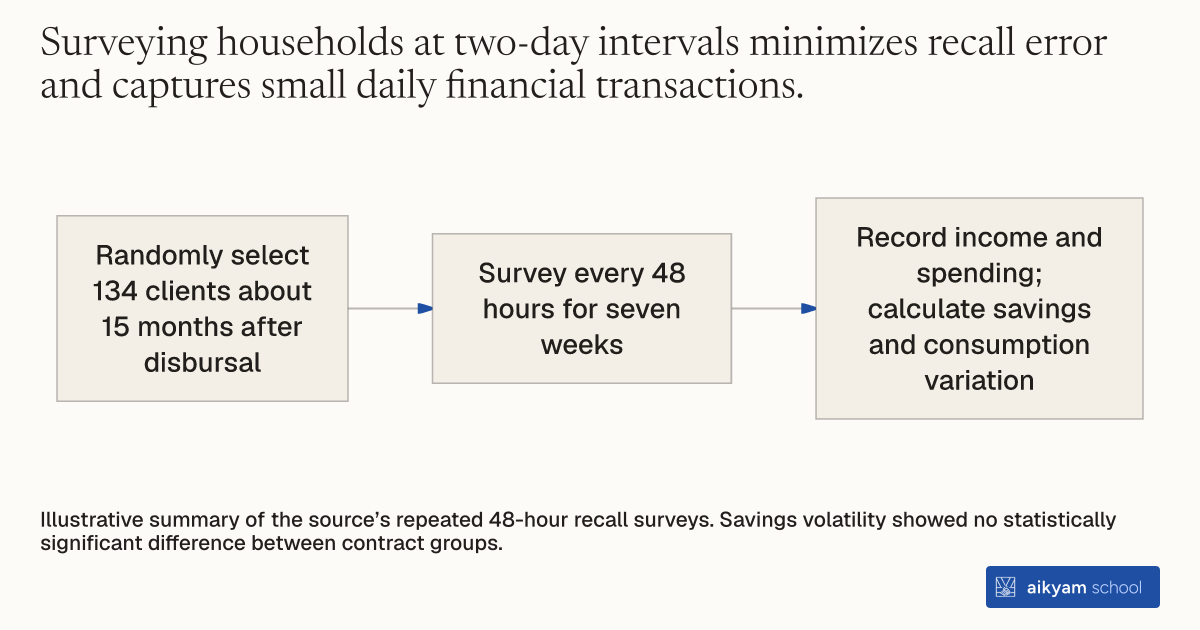
- Randomly select 134 clients about 15 months after disbursal
- Survey every 48 hours for seven weeks
- Record income and spending; calculate savings and consumption variation
Illustrative summary of the source’s repeated 48-hour recall surveys. Savings volatility showed no statistically significant difference between contract groups.
See source →How
When to use
Low-income households in informal urban economies experience volatile daily earnings and expenditures. Standard annual or monthly surveys fail to capture short-term consumption fluctuations and household liquidity adjustments. Administering high-frequency forty-eight hour recall surveys tracks medium-term expenditure patterns and consumption volatility without severe memory decay.
Administer a high-frequency expenditure survey every forty-eight hours across a multi-week observation window to record daily household income and spending.
- Select a random subsample of microfinance clients fifteen months after their initial loan disbursal.
- Visit client households every two days across a continuous seven-week survey period.
- Record itemized income inflows and expenditures incurred during the preceding forty-eight hour window.
- Track spending allocations across business investments, home repairs, food consumption, and cash savings.
- Calculate the coefficient of variation in savings and consumption across survey rounds to evaluate household volatility.
Why it works
Frequent measurements reveal whether flexible debt contracts increase consumption volatility or enable steady household income smoothing.
Example
Survey enumerators tracked 134 microfinance clients in Kolkata, India by conducting forty-eight hour recall interviews every two days over seven weeks roughly fifteen months post-disbursal. The survey confirmed persistent treatment increases in business spending and reduced house repair expenditures without significant differences in savings volatility.
About the study
Participants
134 microfinance clients in Kolkata, India surveyed roughly 15 months after loan disbursal.
Study Design
Randomized high-frequency longitudinal survey gathering income and spending data every 48 hours over seven consecutive weeks across contract groups.
Results
Grace period clients continued to exhibit higher business expenditures and lower house repair spending, reported higher average savings, and showed no statistically significant difference in the coefficient of variation in savings relative to control clients.