Research procedure
Combine observable and peer information
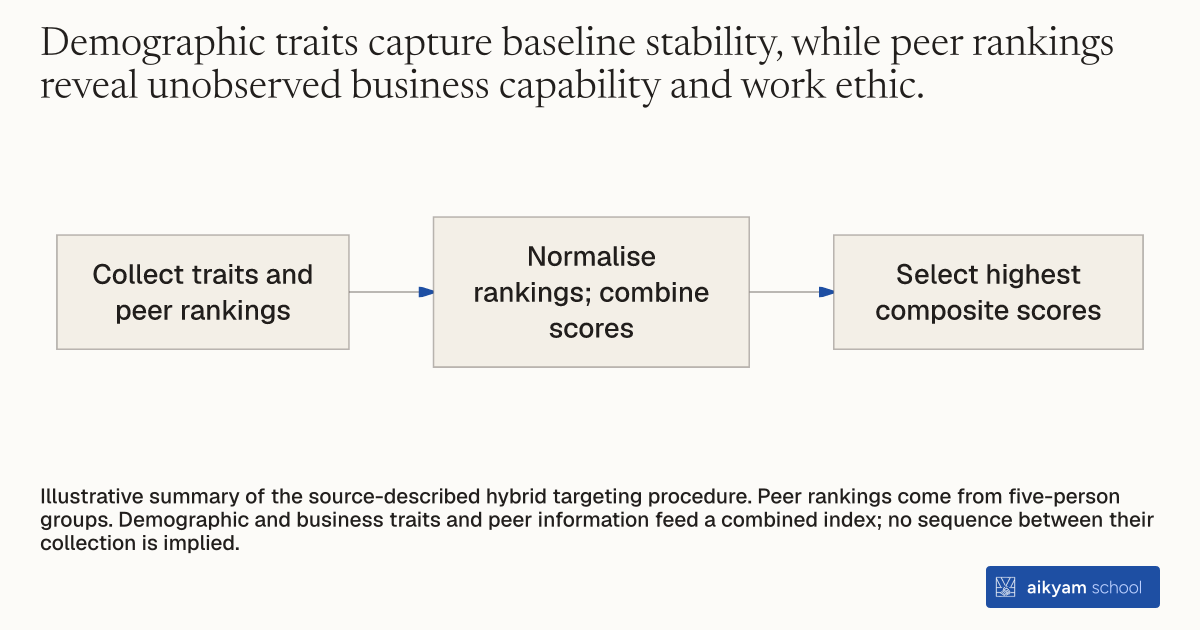
- Collect traits and peer rankings
- Normalise rankings; combine scores
- Select highest composite scores
Illustrative summary of the source-described hybrid targeting procedure. Peer rankings come from five-person groups. Demographic and business traits and peer information feed a combined index; no sequence between their collection is implied.
See source →How
When to use
Lenders and policymakers want to maximize the impact of business loans and grants for microentrepreneurs. Standard selection methods that rely solely on observable traits like age, gender, and education miss hidden entrepreneurial talent. Combining demographic data with community peer rankings creates a hybrid targeting tool that pinpoints top-performing entrepreneurs.
Combine observable demographic characteristics with peer survey rankings to construct a composite scoring model for loan targeting.
- Collect demographic and business characteristics, including age, gender, education, and business assets, during baseline surveys.
- Calculate a baseline suitability score for each applicant based on observable traits.
- Conduct peer ranking surveys within five-person peer groups to gather community predictions on profit growth.
- Normalize peer ranking scores to adjust for relative standing within each group.
- Combine the demographic suitability score and the peer ranking score into a single composite index.
- Select top-scoring microentrepreneurs in the composite index for targeted financial assistance and grants.
Why it works
Merging both sources of information eliminates individual screening blind spots and dramatically increases targeting accuracy.
Example
Researchers evaluated microentrepreneurs in Amravati, Maharashtra, India using observable traits alone versus a hybrid model combining observables and peer information. Microentrepreneurs selected using observable characteristics achieved monthly grant returns of 13.6 percent, while those selected using the combined hybrid model achieved monthly returns of 38 percent.
About the study
Participants
1,345 households across nine peri-urban neighborhoods organized into 274 peer groups of five in Amravati, Maharashtra, India.
Study Design
Randomized controlled trial comparing monthly profit returns on 100 US dollar grants for entrepreneurs selected via observable characteristics alone versus a model combining observables and peer data.
Results
Entrepreneurs ranked in the top third based on observable traits achieved 13.6 percent monthly returns, whereas those selected using both observable traits and community peer information achieved 38 percent monthly returns.