Research steps
Check survey data and re-interview respondents
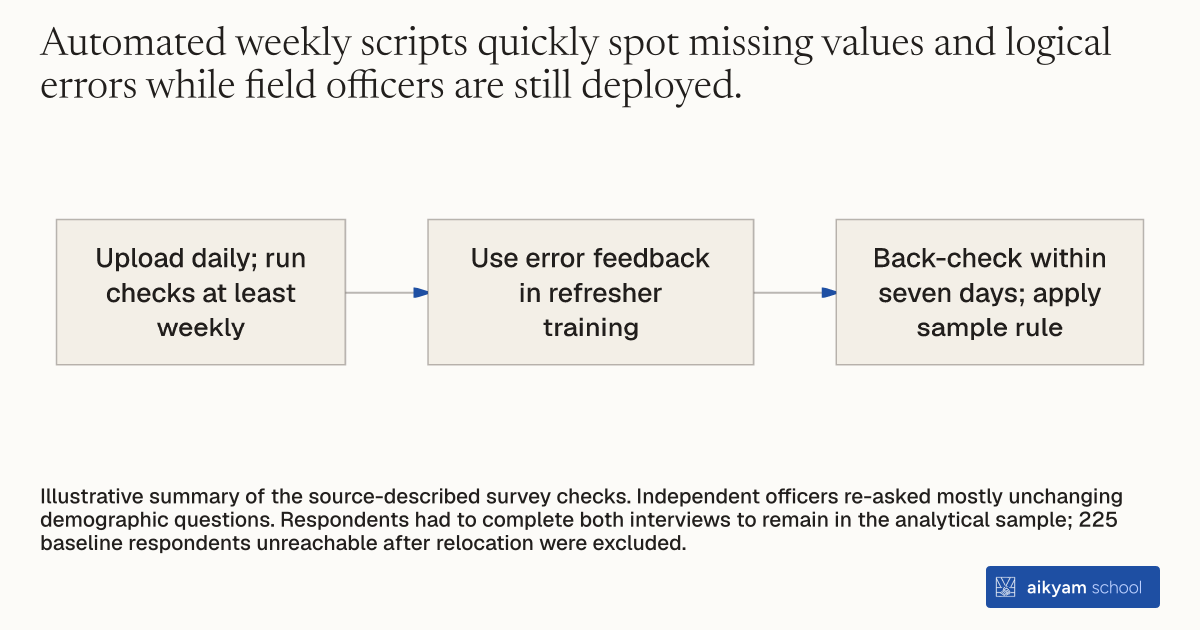
- Upload daily; run checks at least weekly
- Use error feedback in refresher training
- Back-check within seven days; apply sample rule
Illustrative summary of the source-described survey checks. Independent officers re-asked mostly unchanging demographic questions. Respondents had to complete both interviews to remain in the analytical sample; 225 baseline respondents unreachable after relocation were excluded.
See source →How
When to use
Field research projects in low-income settings often suffer from enumerator errors, survey non-completion, and falsification during primary data collection. This method maintains survey data integrity by combining automated server checks with rapid field audits. It serves research organizations conducting large-scale field surveys.
Monitor incoming survey submissions using automated scripts and conduct re-interviews to verify survey accuracy.
- Survey software transmits completed tablet questionnaires from field officers to a central server daily.
- Data analysts execute automated statistical code at least weekly to detect missing entries, outlier values, and logical inconsistencies.
- Project leads review identified data errors and integrate corrective feedback into regular refresher trainings for field officers.
- Independent field officers conduct back-checks with survey respondents within seven days of the initial interview.
- Back-check officers re-survey respondents on immutable demographic traits including age and number of children.
- Data managers require respondents to complete both the initial survey and the back-check to remain in the final analytical sample.
Why it works
Knowing that an independent audit team will re-survey respondents within a week deters data fabrication and maintains enumerator diligence.
Example
During baseline and endline surveys in Nakuru County, Kenya, Busara Center data teams ran weekly automated checks and conducted back-checks across thousands of household respondents. At baseline, 225 respondents who could not be reached for back-checks due to relocation were excluded, helping achieve a 96 percent completion rate at endline.
About the study
Participants
5,756 low-income individuals across 233 rural villages in Nakuru County, Kenya, participating in baseline and 1-year endline surveys.
Study Design
Data quality control integrated into a randomized controlled trial, utilizing weekly automated script checks, independent 1-week back-check surveys, GPS verification, and M-Pesa account matching.
Results
Implementing high-frequency data checks and back-check filters achieved a low 4 to 5 percent overall attrition rate between baseline and 1-year endline surveys, with no differential attrition across treatment groups.