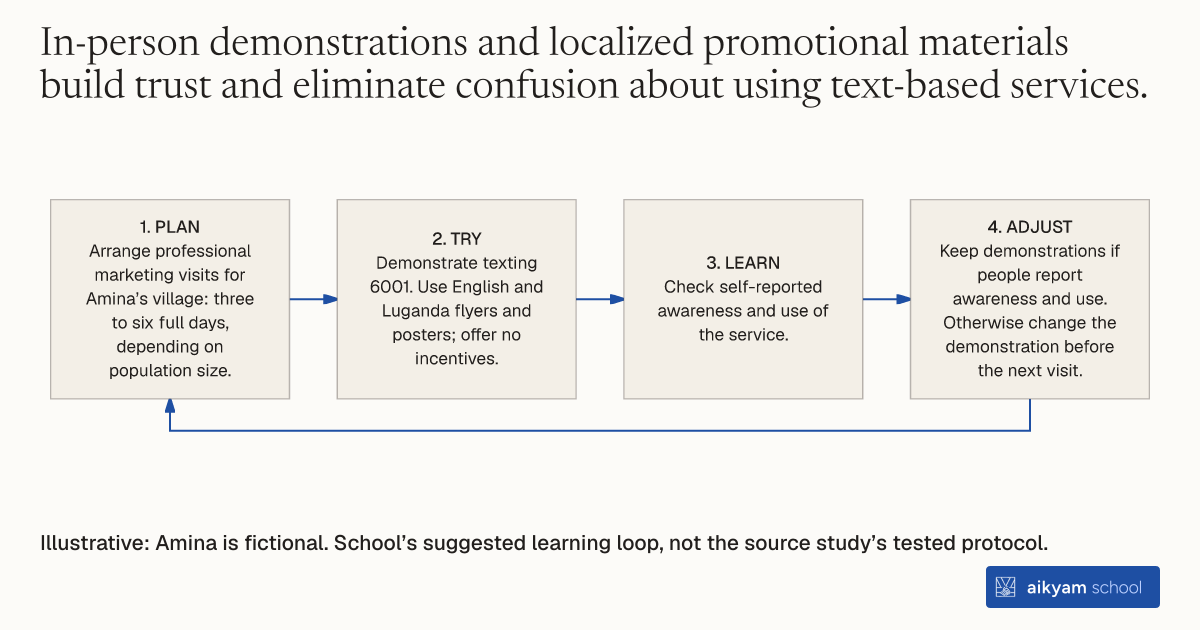
Try, learn and adjust
Check awareness and use after service demonstrations
- Plan: Arrange professional marketing visits for Amina’s village: three to six full days, depending on population size.
- Try: Demonstrate texting 6001. Use English and Luganda flyers and posters; offer no incentives.
- Learn: Check self-reported awareness and use of the service.
- Adjust: Keep demonstrations if people report awareness and use. Otherwise change the demonstration before the next visit.
Illustrative: Amina is fictional. School’s suggested learning loop, not the source study’s tested protocol.
See source →School’s suggested learning loop, not the source’s tested procedure. Observe awareness and use; these checks do not establish health effects.
How
When to use
New mobile services in rural communities often suffer from low initial adoption because potential users are unaware of the service or do not know how to text queries. Rural populations may also hesitate to use unfamiliar digital health tools. This method deploys local marketing teams to conduct live demonstrations and distribute informational materials directly in village trading centers.
Deploy professional marketing teams to village trading centers to demonstrate and promote a new mobile service.
- Program managers contract a professional marketing firm to execute targeted promotional campaigns across target communities.
- Marketing teams visit trading centers three to six times per village depending on local population size.
- Marketers spend a full day during each visit promoting the service through demonstrations, flyers, and posters in English and Luganda.
- Marketing staff present the service as an anonymous and objective source for sexual health information.
- Promotional teams train community members on sending query text messages to short code 6001 without offering monetary or physical incentives.
Why it works
Concentrated village visits raise immediate awareness across the target population without relying on broader media campaigns.
Example
A professional marketing firm promoted the 6001 health texting service across 30 treatment villages in central Uganda by visiting trading centers three to six times for full days with demonstrations, posters, and flyers.
About the study
Participants
2,424 adults aged 18 to 35 with at least six years of primary education in 60 villages across Masaka, Mpigi, Mityana, and Mubende districts in central Uganda.
Study Design
Clustered encouragement-design randomized trial where 30 treatment villages received targeted high-intensity marketing and 30 control villages did not.
Results
Self-reported awareness of the 6001 service reached 48% in treatment villages compared to 24% in control villages, and service usage reached 40% in treatment villages compared to 7% in control villages.