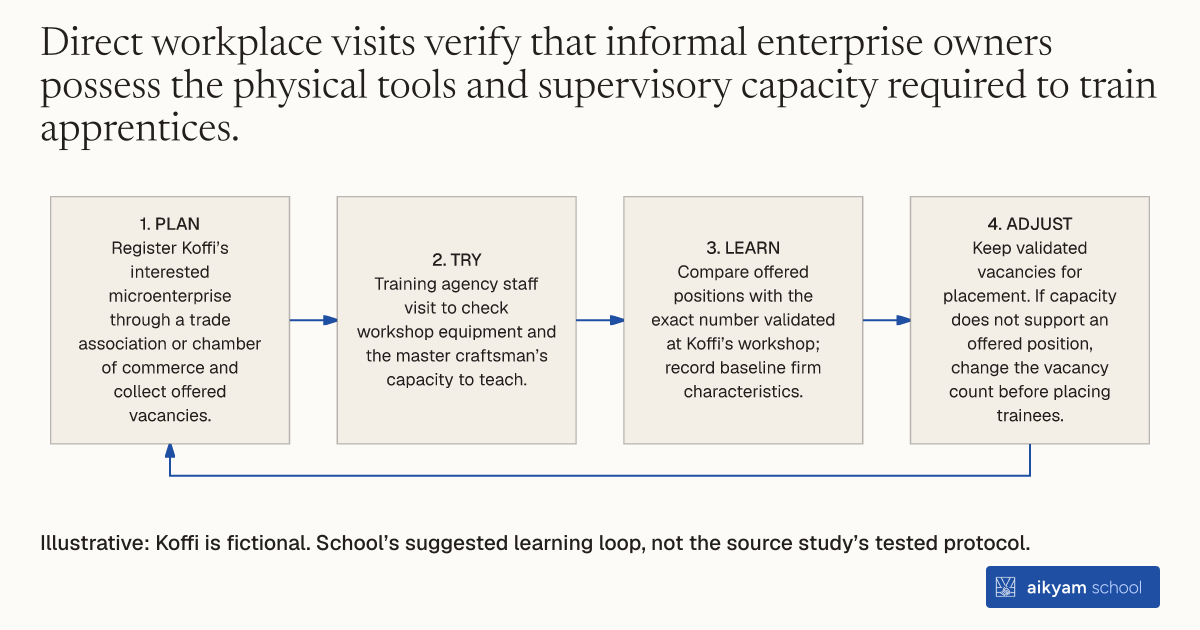
Try, learn and adjust
Verify a host workshop’s training vacancies
- Plan: Register Koffi’s interested microenterprise through a trade association or chamber of commerce and collect offered vacancies.
- Try: Training agency staff visit to check workshop equipment and the master craftsman’s capacity to teach.
- Learn: Compare offered positions with the exact number validated at Koffi’s workshop; record baseline firm characteristics.
- Adjust: Keep validated vacancies for placement. If capacity does not support an offered position, change the vacancy count before placing trainees.
Illustrative: Koffi is fictional. School’s suggested learning loop, not the source study’s tested protocol.
See source →Observe equipment, teaching capacity and confirmed vacancy counts. Verification does not establish apprenticeship impact. School’s suggested learning loop; not a tested source procedure.
How
When to use
Small informal microenterprises in developing economies often lack formal channels to advertise apprenticeship vacancies or verify their training capacity. Public vocational programs need to identify reliable host firms capable of providing effective hands-on mentorship. Systematically visiting local enterprises through business associations verifies training capacity and secures firm commitment to host apprentices.
Identify and verify host microenterprise training vacancies through structured association partnerships and direct workplace visits.
- Partner with local trade associations and chambers of commerce across participating urban centers to register microenterprises interested in taking on apprentices.
- Collect initial counts of open apprenticeship positions offered by each interested firm across target trades.
- Send national training agency staff to visit every registered firm on-site to evaluate the workshop, equipment, and master craftsman capacity to deliver trade instruction.
- Confirm the exact number of validated apprenticeship vacancies each host firm can offer and document firm baseline characteristics before trainee placement.
Why it works
Engaging trade associations builds local business trust and ensures high initial employer registration.
Example
Implementation staff in Côte d'Ivoire collaborated with local chambers of commerce and trade groups across 7 urban localities to register informal microenterprises. Counselors systematically visited every firm, validating training capacity across 731 microenterprises offering an average of 2.51 open apprenticeship positions per firm.
About the study
Participants
731 informal micro and small enterprises (84 percent without formal legal status, 67 percent without accounting records) offering apprenticeship positions across 7 urban localities in Côte d'Ivoire.
Study Design
Double-sided randomized controlled trial pairing firms by trade vacancy structure and randomizing 361 firms to receive formal apprentices and 370 firms to control.
Results
Workplace verification identified 731 firms offering positions, with treatment firms successfully hosting an average inflow of 1.398 formal apprentices and 1.080 net additional total apprentices per enterprise.