Research steps
Collect private peer growth rankings
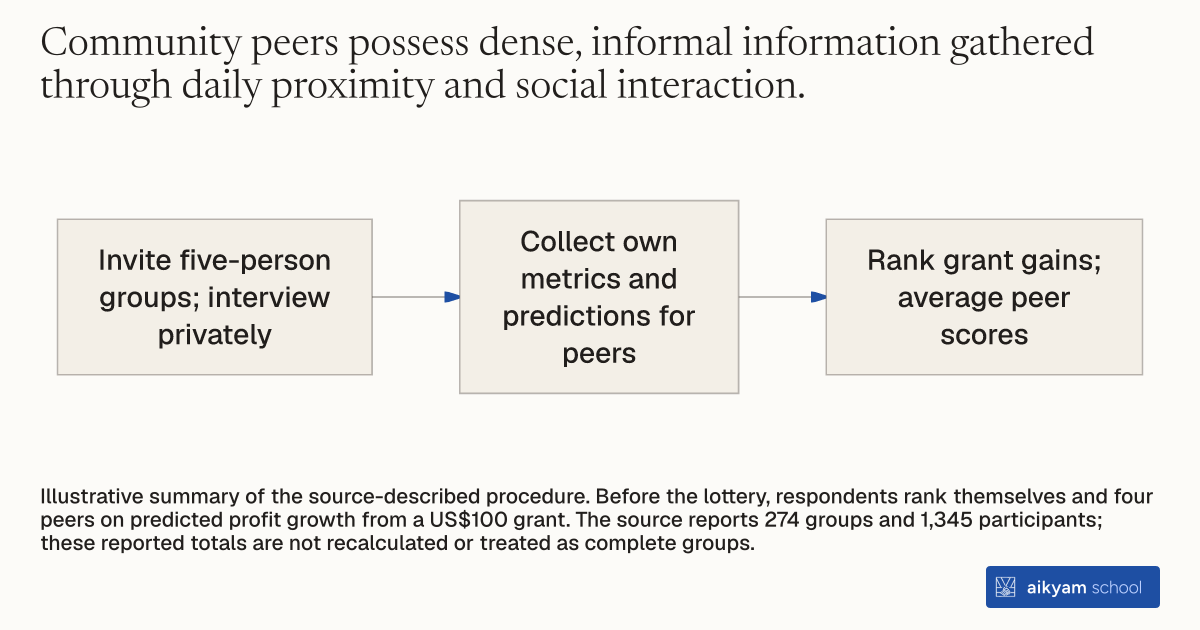
- Invite five-person groups; interview privately
- Collect own metrics and predictions for peers
- Rank grant gains; average peer scores
Illustrative summary of the source-described procedure. Before the lottery, respondents rank themselves and four peers on predicted profit growth from a US$100 grant. The source reports 274 groups and 1,345 participants; these reported totals are not recalculated or treated as complete groups.
See source →How
When to use
Lenders, governments, and non-governmental organizations want to identify high-potential microentrepreneurs to target credit and capital grants effectively. Formal financial records and observable demographic traits fail to capture unobserved entrepreneurial talent. Soliciting private, structured survey rankings from peer groups allows institutions to aggregate local community knowledge.
Administer private surveys to peer group members to collect predictions and rankings regarding enterprise growth potential.
- Invite five-person peer groups of neighboring microentrepreneurs to a local town hall.
- Conduct individual, private survey interviews with each group member.
- Collect baseline self-reported business metrics including revenue, total assets, and monthly profits.
- Ask each participant to report estimated business outcomes for every other member in their five-person group.
- Direct respondents to rank themselves and their four peers on predicted profit growth if awarded a 100 US dollar cash grant.
- Aggregate peer rankings across group members to calculate each entrepreneur's average rank score.
Why it works
Aggregating peer predictions extracts unobservable insights about business talent and operational capability that formal financial screening misses.
Example
Researchers invited 274 five-person peer groups (1,345 microentrepreneurs) to a town hall in Amravati, Maharashtra, India. Before a grant lottery, each participant privately ranked themselves and their four peers on predicted profit growth from receiving a 100 US dollar grant. Entrepreneurs ranked in the top third by peers generated monthly grant returns of 24 to 30 percent, compared to the 10 to 11 percent average.
About the study
Participants
1,345 households organized into 274 peer groups of five in Amravati, Maharashtra, India.
Study Design
Private survey administration asking peer group members to rank peers' predicted profit gains prior to a randomized cash grant distribution.
Results
Microentrepreneurs ranked in the top third by peers achieved monthly returns of 24 to 30 percent on cash grants, around 3 times greater than the overall average return of 10 to 11 percent.