Research steps
Classify parties using journalist interviews
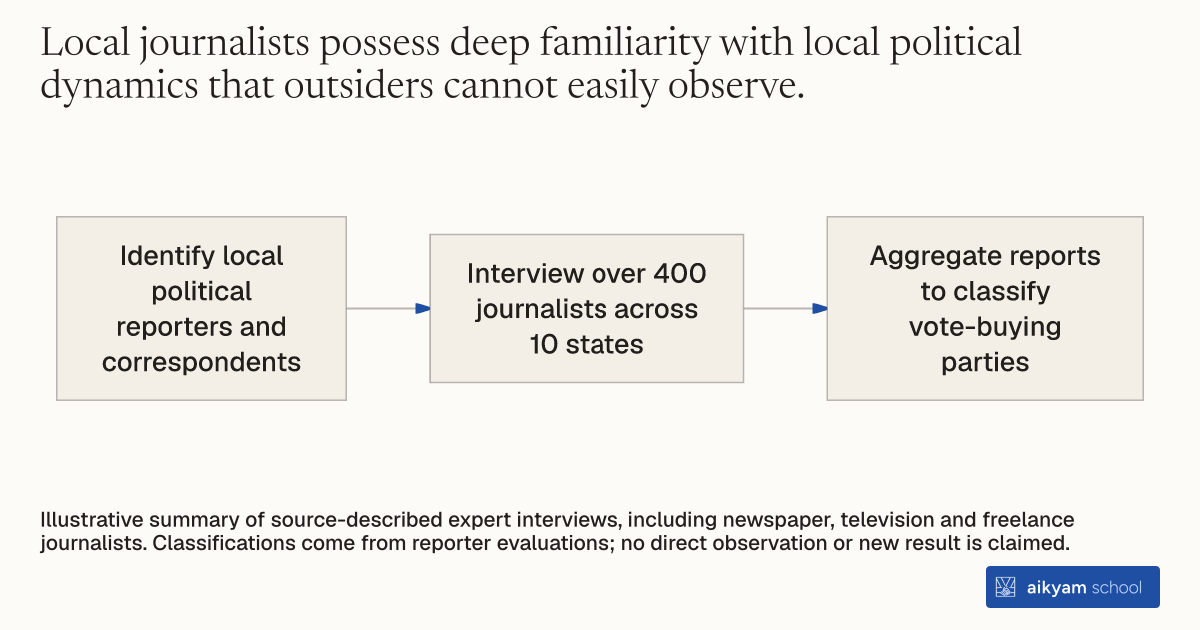
- Identify local political reporters and correspondents
- Interview over 400 journalists across 10 states
- Aggregate reports to classify vote-buying parties
Illustrative summary of source-described expert interviews, including newspaper, television and freelance journalists. Classifications come from reporter evaluations; no direct observation or new result is claimed.
See source →How
When to use
Vote-buying is illegal and covert, making it difficult for outside evaluators to observe directly. Evaluators need a reliable way to identify which political parties engage in vote-buying across large regions. Interviewing local journalists provides expert knowledge to classify corrupt parties before evaluating electoral outcomes.
Interview local political journalists across targeted electoral regions to determine which political parties engage in vote-buying.
- Research teams identify media professionals covering local politics across target election regions.
- Interviewers contact reporters for English, Hindi, and local language newspapers, news channel correspondents, and freelancers.
- Interviewers conduct systematic interviews with over 400 local journalists across 10 states.
- Analysts aggregate reporter evaluations to identify and classify vote-buying political parties in each state.
Why it works
Surveying a wide network of local media members provides accurate information on clandestine vote-buying practices.
Example
Researchers interviewed over 400 local journalists across 10 states in India to classify vote-buying parties during the 2014 general election.
About the study
Participants
Over 400 local journalists in 10 states in India, including newspaper reporters, television correspondents, and freelancers.
Study Design
Structured expert interviews across 10 states to categorize political parties according to their vote-buying practices.
Results
Successfully determined vote-buying parties across constituencies covered by 60 public radio stations in 10 states.