Research design
Choose a target and reward
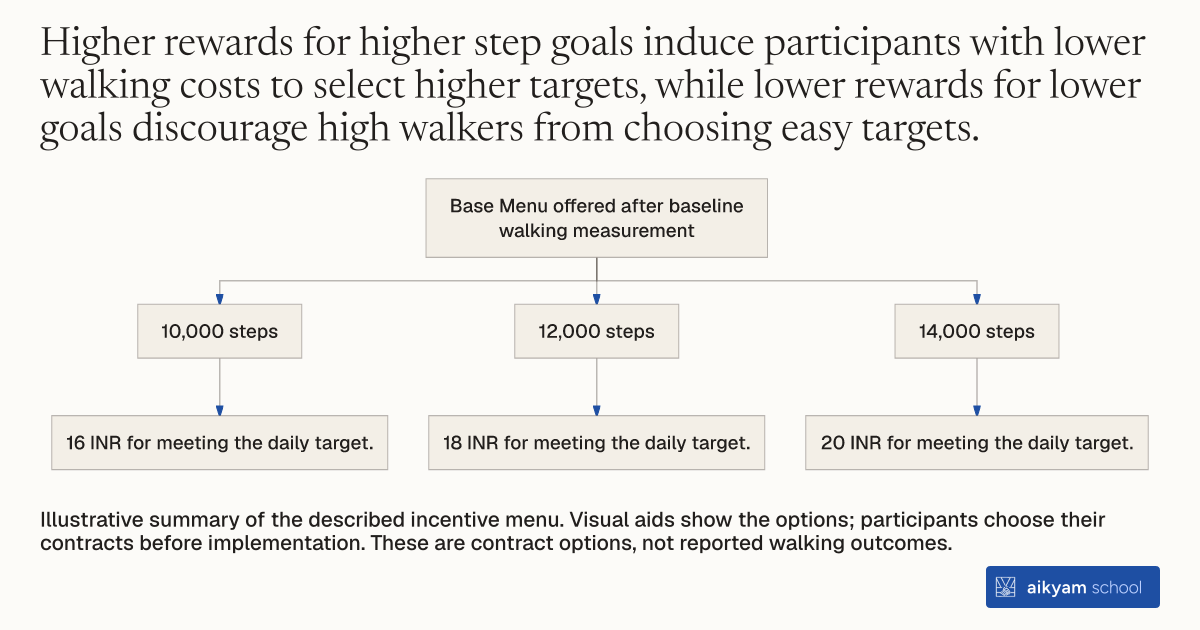
Base Menu offered after baseline walking measurement
- 10,000 steps
- 16 INR for meeting the daily target.
- 12,000 steps
- 18 INR for meeting the daily target.
- 14,000 steps
- 20 INR for meeting the daily target.
Illustrative summary of the described incentive menu. Visual aids show the options; participants choose their contracts before implementation. These are contract options, not reported walking outcomes.
See source →How
When to use
Health programs using financial incentives to increase physical activity often face unobservable differences in baseline effort across participants. Offering a uniform reward structure overpays individuals who walk naturally while under-motivating lower-activity individuals. Offering an incentive-compatible choice menu allows participants to self-select contract targets that match their individual effort costs without inflating program budgets.
Personalize exercise incentive programs by offering participants a menu of contracts where rewards increase alongside step targets to induce self-selection.
- Survey baseline walking habits over an initial monitoring period to establish the distribution of participant activity types.
- Select candidate daily step targets corresponding to low, medium, and high baseline walking terciles.
- Establish higher financial reward levels for higher daily step targets to make higher targets attractive to high walkers while preserving participation for low walkers.
- Present visual choice aids depicting the contract options to eligible participants prior to program launch.
- Record each participant's self-selected contract from the menu and implement their chosen daily step target and payment rate for the program duration.
Why it works
Sorting participants into tailored contracts increases overall activity without raising total reward payments.
Example
In Coimbatore, India, researchers offered 970 adults with diabetes or hypertension a Choice menu featuring three contracts (10,000 steps at 16 INR, 12,000 steps at 18 INR, and 14,000 steps at 20 INR), resulting in 59% choosing the 10,000 step target, 21% choosing the 12,000 step target, and 20% choosing the 14,000 step target.
About the study
Participants
6,882 adults aged 30 to 65 (mean age 49, 37% female, 31% diabetic, 32% hypertensive) in urban Coimbatore, Tamil Nadu, India, including 970 participants in the primary Choice group and 1,274 in the Fixed Medium group.
Study Design
Randomized controlled trial comparing an incentive-compatible Choice menu (10K steps at 16 INR, 12K steps at 18 INR, 14K steps at 20 INR) against a prespecified one-size-fits-all Fixed Medium contract (12K target at 20 INR) over a 4-week contract period with pedometer tracking.
Results
Offering the Choice menu increased daily walking by 420 additional steps (an 80% improvement in treatment effect) relative to the one-size-fits-all 12K target without significantly increasing average daily payments (0.47 INR increase).