Research records
Measure beliefs on both sides of the market
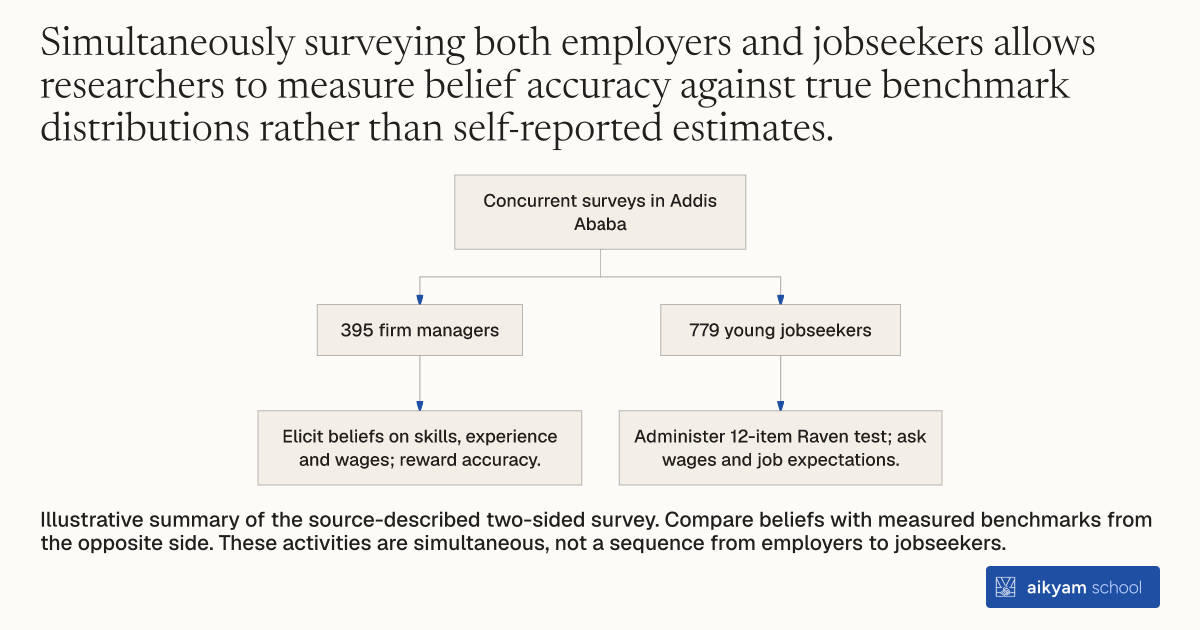
Concurrent surveys in Addis Ababa
- 395 firm managers
- Elicit beliefs on skills, experience and wages; reward accuracy.
- 779 young jobseekers
- Administer 12-item Raven test; ask wages and job expectations.
Illustrative summary of the source-described two-sided survey. Compare beliefs with measured benchmarks from the opposite side. These activities are simultaneous, not a sequence from employers to jobseekers.
See source →How
When to use
Use this method when measuring whether structural misperceptions exist on both sides of a labor market. It addresses the problem of unobservable beliefs about candidate ability, hiring probabilities, and reservation wages. It serves researchers, survey managers, and labor economists diagnosing information frictions.
Administer simultaneous belief-elicitation surveys to representative samples of employers and jobseekers using standardized skill tests and financial accuracy incentives.
- Recruit separate, representative samples of active jobseekers and hiring firm managers from job advertising boards and employment venues.
- Provide firm managers with instructions and benchmark score distributions for a standardized 12-item Raven progressive matrices test.
- Elicit firm managers' expectations regarding the average test scores, work experience, and acceptable starting wages of jobseekers across educational tiers.
- Incentivize firm manager answers by randomly selecting one belief question at survey completion to award a cash prize based on accuracy.
- Administer the 12-item Raven test to surveyed jobseekers to obtain the true population score distribution.
- Survey jobseekers on their reservation wages, sectoral wage distributions, and expected time to secure permanent employment.
- Compare elicited beliefs on each side of the market against the true benchmark distributions measured on the opposite side.
Why it works
Financial incentives encourage firm managers to report thoughtful, unstated expectations about candidate quality and hiring constraints.
Example
Researchers in Addis Ababa, Ethiopia surveyed 395 firm managers and 779 young jobseekers recruited at central job boards. They benchmarked manager expectations against actual Raven test scores and found 75 percent of firms overestimated candidate cognitive ability, while 55 percent of high-school jobseekers overestimated permanent job-finding rates within one year.
About the study
Participants
N = 395 firm managers and N = 779 young jobseekers (aged 18 to 29) in Addis Ababa, Ethiopia.
Study Design
Cross-sectional two-sided belief-elicitation survey with incentivized scoring for employers and direct cognitive testing (12-item Raven test) for jobseekers.
Results
Revealed that 75% of firm managers overestimated the cognitive ability of tertiary-educated applicants, while 55% of high-school educated jobseekers expected permanent employment within 1 year compared to a 5.8% actual observed rate.