Research steps
Use fingers to express perceived malaria risk
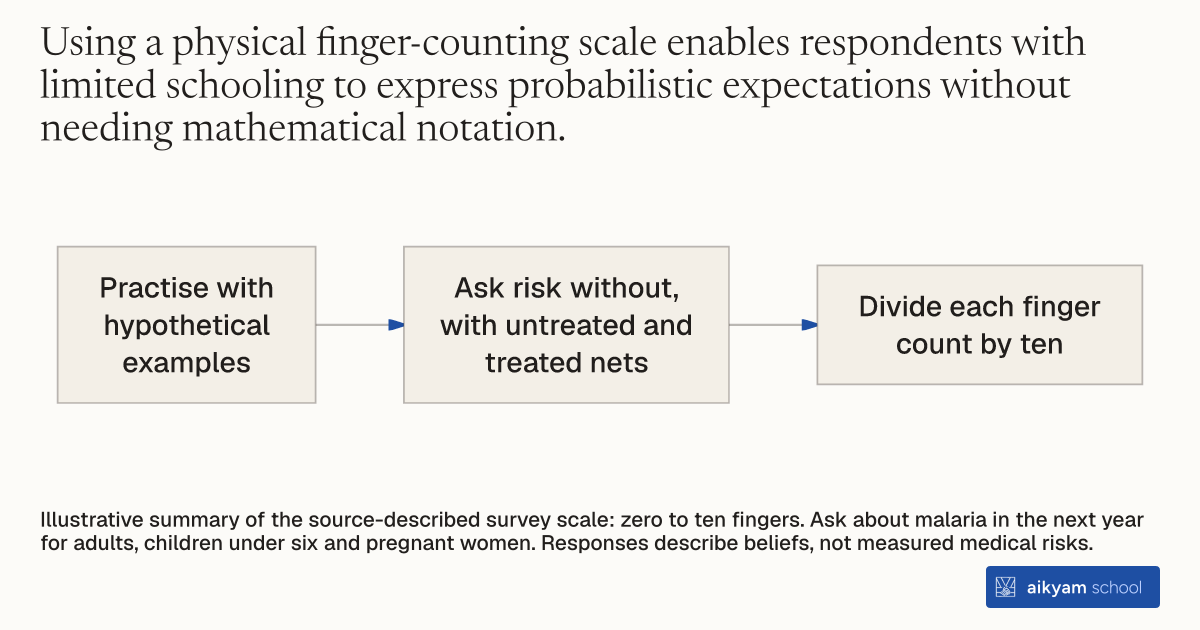
- Practise with hypothetical examples
- Ask risk without, with untreated and treated nets
- Divide each finger count by ten
Illustrative summary of the source-described survey scale: zero to ten fingers. Ask about malaria in the next year for adults, children under six and pregnant women. Responses describe beliefs, not measured medical risks.
See source →How
When to use
Researchers need to measure subjective health beliefs among populations with low formal education. Standard survey questions using percentage probabilities often confuse respondents who lack formal mathematical training. This technique translates abstract probability concepts into a simple physical scale using hands and fingers.
Measure subjective expectations about disease risks and health technology effectiveness by administering a visual finger-counting scale to survey respondents.
- Train survey interviewers to introduce hypothetical training examples to ensure that respondents understand the finger-counting procedure.
- Ask the respondent to hold up zero to ten fingers to represent the likelihood of a specific health event occurring.
- Elicit baseline risk beliefs by asking respondents for the probability that a household member contracts malaria in the next year without a net.
- Elicit conditional efficacy beliefs by repeating the question for hypothetical scenarios where household members regularly use an untreated bednet or an insecticide-treated net.
- Calculate the subjective probability for each scenario by dividing the reported number of held-up fingers by ten.
Why it works
Dividing the finger count by ten directly converts physical responses into bounded subjective probabilities between zero and one.
Example
Surveyors interviewed adult respondents across 1,947 households in 150 rural villages in Orissa, India, during May–June 2007. Respondents held up an average of 9.3 fingers for children under six contracting malaria without a net, 4.9 fingers with an untreated net, and 0.7 fingers with an insecticide-treated net.
About the study
Participants
1,947 households with 10,641 members across 150 villages in Bargarh, Balangir, Kandhamal, Keonjhar, and Sambalpur districts in Orissa, India, where over 90 percent of the population belongs to Scheduled Castes, Scheduled Tribes, or Other Backward Castes.
Study Design
A household survey administered a 0 to 10 finger scale to elicit subjective probabilities of contracting malaria across 3 net-use scenarios for adults, children under six, and pregnant women.
Results
Mean elicited probabilities for contracting malaria in the next year were 0.93 without a net, 0.49 with an untreated net, and 0.07 with an ITN for children under six, compared to 0.90 without a net, 0.46 with an untreated net, and 0.06 with an ITN for adults.