Research steps
Independently audit survey recordings
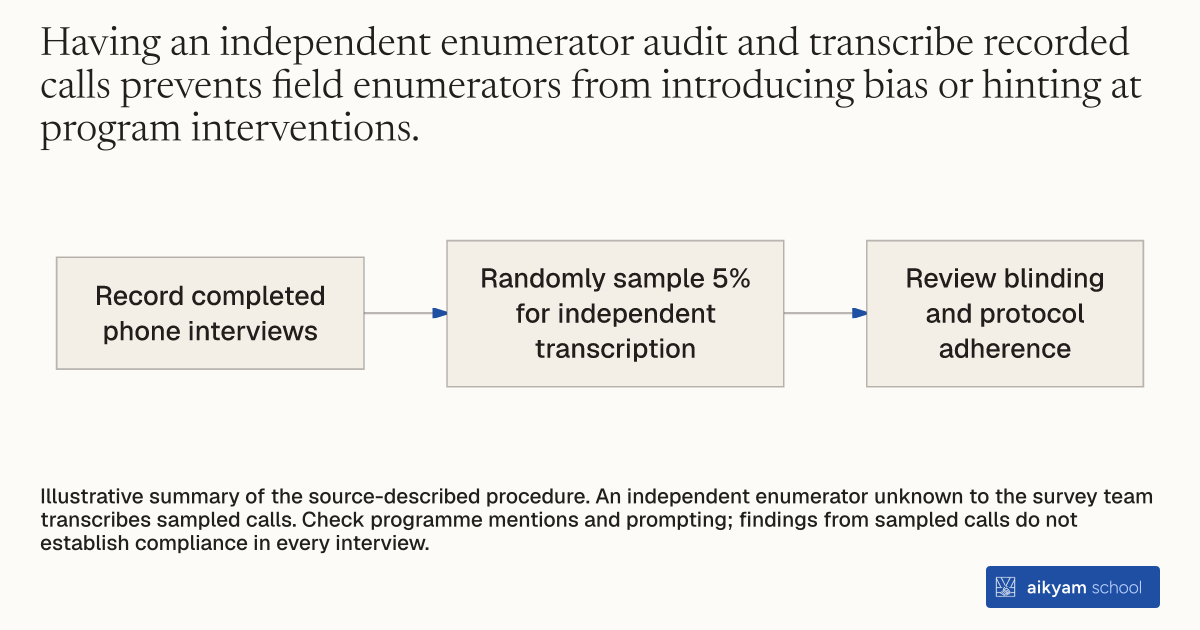
- Record completed phone interviews
- Randomly sample 5% for independent transcription
- Review blinding and protocol adherence
Illustrative summary of the source-described procedure. An independent enumerator unknown to the survey team transcribes sampled calls. Check programme mentions and prompting; findings from sampled calls do not establish compliance in every interview.
See source →How
When to use
Survey research teams conducting phone-based evaluations face potential enumerator bias, protocol deviations, or respondent prompting during remote data collection. Implementing independent audio audits verifies data accuracy and ensures enumerator adherence without alerting field staff. This method is intended for research organizations and survey managers conducting phone surveys in evaluation studies.
Conduct independent audio audits on a randomized sample of recorded phone survey calls to verify data accuracy and enumerator compliance.
- Audio-record completed phone survey calls during data collection across treatment and control groups.
- Select a random sample of 5% of all completed survey call recordings for independent audit.
- Assign the sampled call recordings to an independent enumerator who is unknown to the primary survey team.
- Have the independent enumerator listen to and transcribe the sampled audio recordings.
- Review transcripts to confirm that enumerators remain blind to treatment status, avoid mentioning program details, and strictly adhere to survey protocol.
Why it works
Auditing a random sample provides objective quality control while verifying data integrity across survey rounds.
Example
In western Uganda, researchers conducted audio audits on 5% of phone surveys during a lean-season follow-up call, confirming through independent transcription that no mention of the RTV program occurred and verifying survey data quality.
About the study
Participants
3,734 completed phone surveys from a sample of 3,852 rural households across 335 villages in Kagadi and Kyenjojo districts, western Uganda.
Study Design
Independent quality control audit of a 5% random sample of phone survey recordings conducted during a 19-minute lean-season follow-up evaluation.
Results
Audio audits of 5% of all phone surveys confirmed zero mentions of the RTV program, verifying that enumerators remained blinded and confirming phone survey data quality.