Research steps
Measure welfare in two agricultural seasons
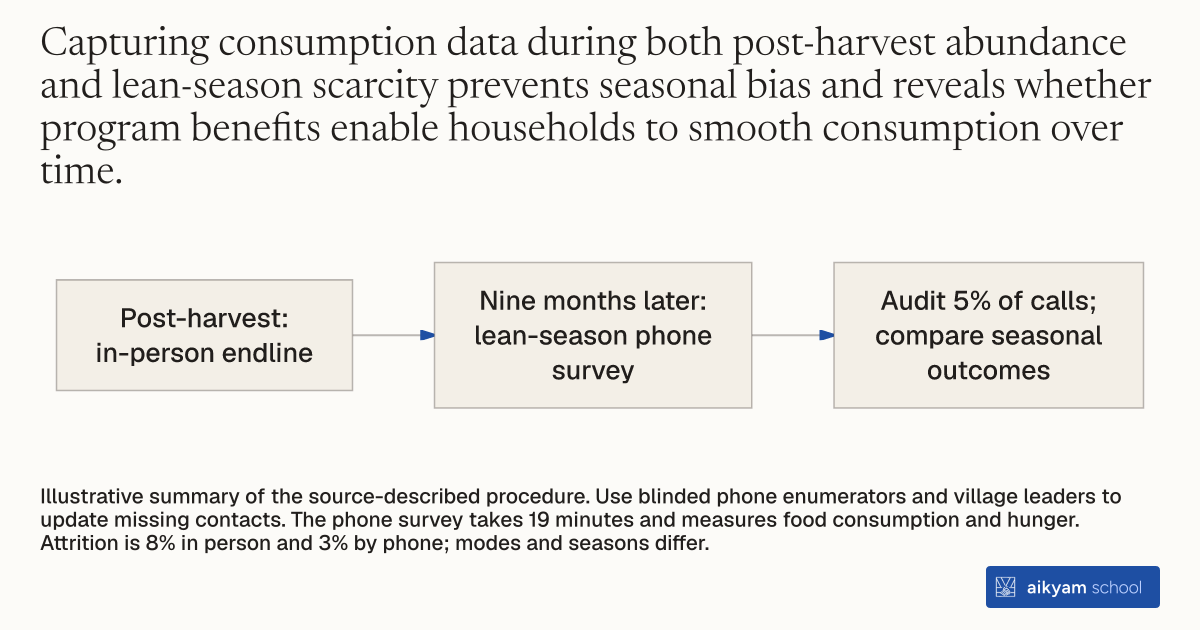
- Post-harvest: in-person endline
- Nine months later: lean-season phone survey
- Audit 5% of calls; compare seasonal outcomes
Illustrative summary of the source-described procedure. Use blinded phone enumerators and village leaders to update missing contacts. The phone survey takes 19 minutes and measures food consumption and hunger. Attrition is 8% in person and 3% by phone; modes and seasons differ.
See source →How
When to use
Evaluating agricultural anti-poverty programs solely using in-person post-harvest surveys risks overestimating welfare gains by measuring household outcomes during seasonal peak abundance. Implementing a multi-mode survey evaluation that combines in-person post-harvest interviews with short lean-season phone surveys captures seasonal variations in consumption and hunger. This method is intended for researchers and development evaluators seeking to measure year-round welfare impacts and consumption smoothing.
Evaluate year-round program impacts by pairing comprehensive in-person post-harvest household surveys with targeted phone surveys during the agricultural lean season.
- Conduct an in-person endline survey with all sample households immediately following a major harvest to capture detailed crop yields, sales, expenditures, assets, and health outcomes.
- Schedule a short follow-up phone survey approximately nine months later during the agricultural lean season to measure food consumption and hunger indicators.
- Blind enumerators to treatment status during phone interviews to eliminate surveyor bias during data collection.
- Utilize village leadership to track uncontacted respondents and update changed phone numbers to maintain low survey attrition.
- Perform independent audio audits on a random subset of phone interviews, such as 5% of completed calls, to verify data quality and confirm enumerator compliance.
Why it works
Using village leaders to track phone numbers maintains high follow-up rates, while audio audits ensure data integrity.
Example
In rural western Uganda, researchers surveyed nearly 4,000 households across 335 villages in person post-harvest and followed up nine months later with a 19-minute lean-season phone survey, finding that monthly consumption treatment effects were USD 58.807 PPP post-harvest and USD 150.149 PPP during the lean season.
About the study
Participants
3,852 households across 335 villages in Kagadi and Kyenjojo districts, western Uganda, where 35% of households fall below the \$2.15 PPP daily poverty line post-harvest and 65% during the lean season.
Study Design
Clustered randomized controlled trial across 114 village clusters covering 335 villages, comparing a universal livelihoods program to a pure control group using in-person endline surveys and a 19-minute lean-season phone survey.
Results
Endline in-person survey achieved an 8% attrition rate, while the lean-season phone survey achieved a 3% attrition rate; consumption poverty in control villages rose from 35% post-harvest to 65% in the lean season, while treatment reduced lean-season consumption poverty by 26.3 percentage points (p < 0.01) and increased lean-season monthly consumption by USD 150.149 PPP (p < 0.01).