Try, learn and adjust
Check vaccination history is recorded
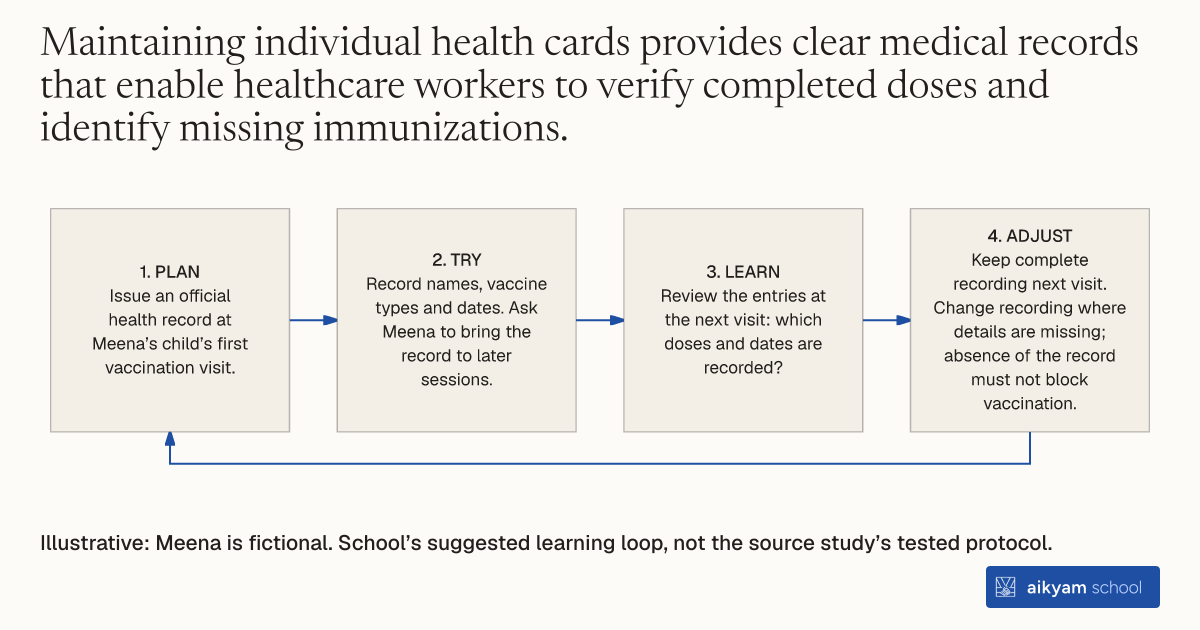
- Plan: Issue an official health record at Meena’s child’s first vaccination visit.
- Try: Record names, vaccine types and dates. Ask Meena to bring the record to later sessions.
- Learn: Review the entries at the next visit: which doses and dates are recorded?
- Adjust: Keep complete recording next visit. Change recording where details are missing; absence of the record must not block vaccination.
Illustrative: Meena is fictional. School’s suggested learning loop, not the source study’s tested protocol.
See source →School’s suggested, untested loop. Observe recorded history. The source says to vaccinate even without the record when prior status cannot be established; this loop is not clinical guidance.
How
When to use
In rural low-income areas, children frequently miss scheduled vaccinations because health workers and parents lack reliable records of past immunizations. When families visit health camps, assessing missing vaccine doses without documentation leads to uncertainty or omitted immunizations. Issue official individual health cards to maintain accurate records of each child's identity, vaccination dates, and completed doses.
Issue and maintain individual official health cards at vaccination visits to track immunization history and verify full course completion.
- Issue an official immunization card to each child during their first vaccination visit at the clinic or camp.
- Record the child's name, parent's name, and the specific date and type of each immunization administered on the card.
- Require parents to bring the health card to every subsequent immunization session.
- Verify compliance with the full vaccination course using entries recorded on the child's health card.
- Administer vaccinations even if a child arrives without a card and prior immunization status cannot be ascertained.
Why it works
Written records also allow health programs to verify full vaccination compliance objectively.
Example
In tribal villages of Udaipur district, India, mobile teams issued health cards recording the child's name, parent's name, and vaccination history at the child's first visit. Using health cards to track compliance, full immunization rates among children aged 1 to 3 years rose to 38.3 percent when paired with incentives.
About the study
Participants
134 villages with almost 2,000 children under five in Udaipur District, Rajasthan, India.
Study Design
Clustered randomized controlled trial using health cards to track and verify immunization history across comparison and intervention villages.
Results
Verifying vaccination history using child health cards showed full immunization rates reached 38.3 percent in incentive villages and 16.6 percent in camp-only villages, compared to 6.2 percent in comparison villages.