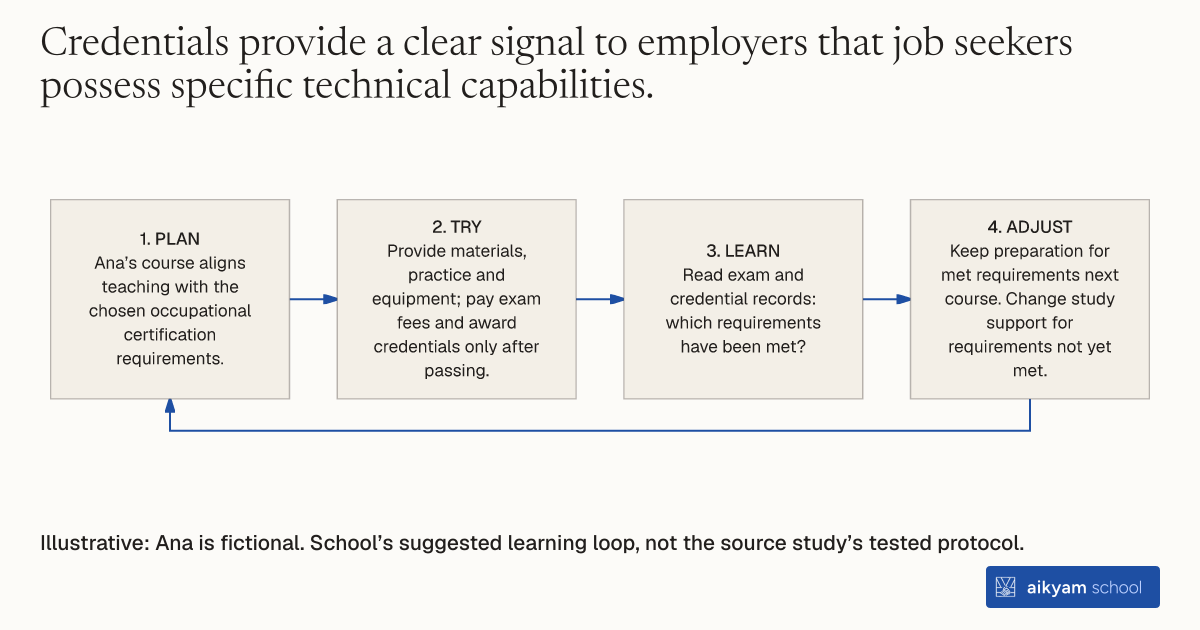
Try, learn and adjust
Check credential preparation and results
- Plan: Ana’s course aligns teaching with the chosen occupational certification requirements.
- Try: Provide materials, practice and equipment; pay exam fees and award credentials only after passing.
- Learn: Read exam and credential records: which requirements have been met?
- Adjust: Keep preparation for met requirements next course. Change study support for requirements not yet met.
Illustrative: Ana is fictional. School’s suggested learning loop, not the source study’s tested protocol.
See source →School’s suggested, untested learning loop. Observe exam participation, results and credentials; programme earnings gains are not proof of the credential component alone.
How
When to use
Non-college workers often struggle to prove their technical skills to employers without formal qualifications. Uncertified work experience fails to transfer across companies or guarantee higher starting pay. Program managers solve this problem for low-income job seekers by embedding recognized professional certifications into skill training.
Integrate industry-recognized credential preparation and testing into sector training programs.
- Identify recognized occupational certifications in target industries such as computer repair or nursing assistance.
- Align classroom instruction with the official skill requirements set by certification boards.
- Supply required study materials, practice tests, and laboratory equipment during training.
- Pay exam registration fees so participants take certification tests at no personal cost.
- Award official credentials to participants who pass required certification exams.
Why it works
Portable credentials allow graduates to move between firms and command higher wages across the sector.
Example
Per Scholas trained participants in the Bronx to earn A Plus and Network Plus credentials in the information technology sector.
About the study
Participants
Human low-income adult and youth job seekers across nine sectoral programs evaluated in four US studies.
Study Design
Four randomized evaluations compared outcomes of participants earning sector credentials against control group members over two to eleven years.
Results
Credential attainment contributed to hourly wage increases of nearly \$4 per hour (a 31.7 percent increase, p < 0.01) in YearUp and increased the share of participants in higher-paying jobs by 14 percentage points in the Sectoral Employment Impact Study (59 percent versus 45 percent, p < 0.01).