Try, learn and adjust
Check adult and child support run together
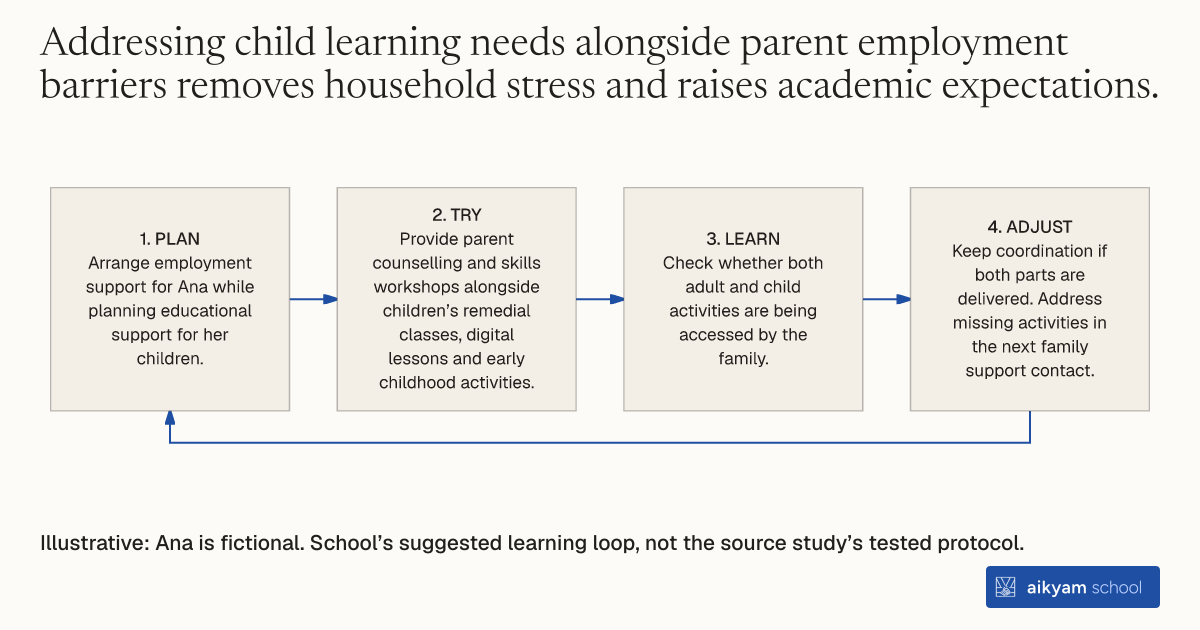
- Plan: Arrange employment support for Ana while planning educational support for her children.
- Try: Provide parent counselling and skills workshops alongside children’s remedial classes, digital lessons and early childhood activities.
- Learn: Check whether both adult and child activities are being accessed by the family.
- Adjust: Keep coordination if both parts are delivered. Address missing activities in the next family support contact.
Illustrative: Ana is fictional. School’s suggested learning loop, not the source study’s tested protocol.
See source →School’s suggested, untested loop: observe simultaneous adult and child support. This check does not require one part to finish before the other starts.
How
When to use
Low-income households with children face intergenerational poverty cycles where adult employment barriers and child educational deficits reinforce each other. Standard adult-only or child-only welfare programs fail to address these interconnected family needs simultaneously. This method delivers integrated employment and educational support to vulnerable families.
Deliver simultaneous adult employment services and child educational interventions to vulnerable households.
- Program staff provide parents with fourteen individual counseling sessions and three group workshops per month on professional and digital competencies.
- Advisors deliver six individual career guidance sessions to parents who secure job placements.
- Educators provide children with four hours of remedial academic classes per week and weekly digital literacy lessons.
- Program facilitators run early childhood educational spaces four to six hours per week and lead parenting skills workshops.
- Staff connect family members to non-formal educational activities that promote values, sports, and creativity.
Why it works
Simultaneous support boosts family economic resources while directly elevating children's educational performance.
Example
Save the Children implemented a two-generational support program for 3,133 people in 792 families across four Spanish cities over twelve months. Parents received professional skills sessions and job counseling while children attended weekly remedial classes and early childhood spaces. Participating families achieved lower material and social deprivation, higher monthly income, elevated parental academic expectations, and improved child test scores in language and mathematics.
About the study
Participants
3,133 individuals across 792 families in 4 Spanish cities.
Study Design
Cluster Randomised Controlled Trial (RCT) evaluating a 12-month multi-arm program (educational, employment, combined, and comparison) implemented by Save the Children.
Results
The combined treatment reduced material and social deprivation, increased monthly household income, raised parents' expectations for their children's academic performance, and improved standardized test scores in language and mathematics, though it did not improve self-reported employment or job search intensity.