Try, learn and adjust
Check vocational learning reaches workplace practice
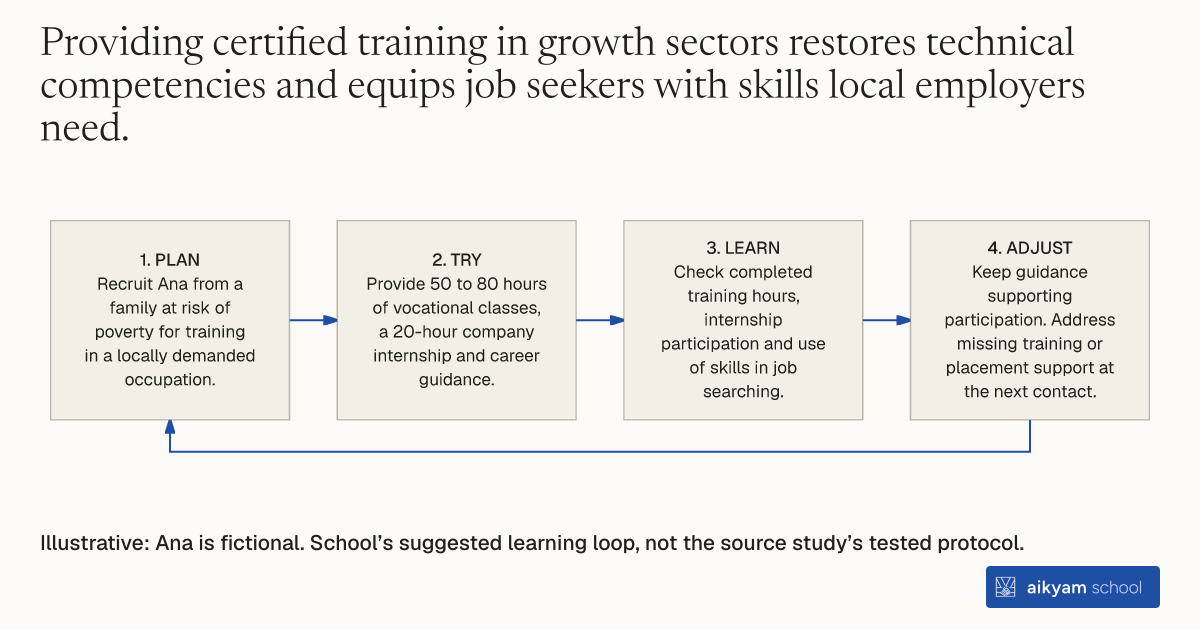
- Plan: Recruit Ana from a family at risk of poverty for training in a locally demanded occupation.
- Try: Provide 50 to 80 hours of vocational classes, a 20-hour company internship and career guidance.
- Learn: Check completed training hours, internship participation and use of skills in job searching.
- Adjust: Keep guidance supporting participation. Address missing training or placement support at the next contact.
Illustrative: Ana is fictional. School’s suggested learning loop, not the source study’s tested protocol.
See source →School’s suggested, untested loop: observe training and internship completion; the trial did not increase short-term employment probability.
How
When to use
Low-income job seekers at risk of poverty face skills decay and difficulty securing technical jobs without direct corporate experience. Standard short workshops fail to provide industry-recognised qualifications or practical work history. This method combines intensive vocational training in high-demand occupations with a short corporate internship to improve job search resilience and workplace readiness.
Deliver intensive vocational classroom training in in-demand sectors paired with a short host-company internship.
- Social caseworkers recruit working-age members of families at risk of poverty for vocational retraining.
- Instructors lead 50 to 80 hours of intensive classroom training focused on specific high-demand local occupations.
- Program coordinators place participants in a 20-hour practical internship with local host companies.
- Advisors deliver career guidance to assist participants in applying their new technical skills to active job searching.
Why it works
Adding a short internship gives participants real-world workplace exposure, building psychological resilience and job search organization.
Example
The Ayuntamiento de Santander in Cantabria, Spain evaluated intensive vocational training and internships for job seekers across 327 families at risk of poverty. Participants completed 50 to 80 hours of vocational classes in high-demand municipal occupations and a 20-hour firm internship over two months. The intervention improved participants' resilience, job search proactivity, organization, and overall job search behaviors.
About the study
Participants
365 working-age individuals across 327 families at risk of poverty in Santander, Spain.
Study Design
Randomised Controlled Trial (RCT) evaluating 50 to 80 hours of vocational training and a 20-hour corporate internship delivered over 2 months.
Results
The vocational training improved resilience, an overall indicator of job search behaviours and attitudes, as well as proactivity, organisation, and behaviour in job searching, but did not increase short-term employment probability.