In Simple Words
Attempting to teach new technical skills to someone who lacks belief in their own abilities is like building a house on soft sand. Running short empowerment workshops acts like compacting the ground beneath the foundation, giving participants the psychological strength and proactivity needed to engage in intensive job training and internships.
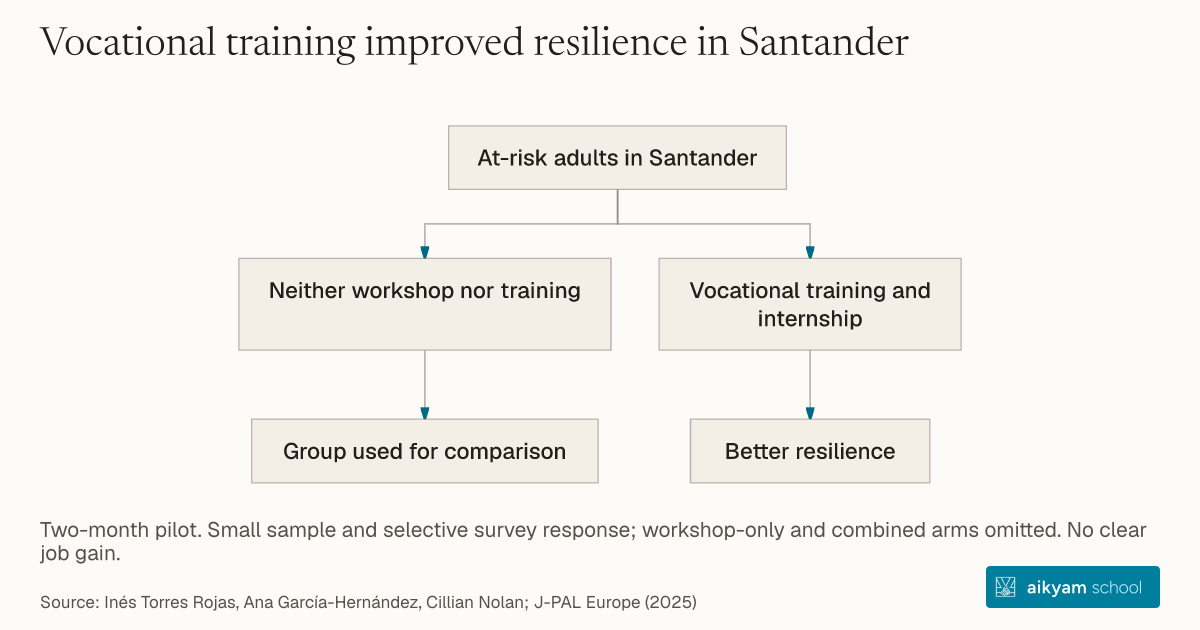
At-risk adults in Santander
- Neither workshop nor training
- Group used for comparison
- Vocational training and internship
- Better resilience
Two-month pilot. Small sample and selective survey response; workshop-only and combined arms omitted. No clear job gain.
See source →Research question
Vulnerable individuals at risk of poverty experience low self-esteem and unproactive job search behaviors, which hinders their ability to participate effectively in vocational training or enter competitive labor markets.
Participants
365 working-age individuals in 327 families at risk of poverty in Santander, Spain (73 Treatment 1, 47 Treatment 2, 68 Treatment 3, 177 comparison).
Study Design
Randomised Controlled Trial (RCT) evaluating 15 hours of empowerment workshops (Treatment 1), 50–80 hours of intensive vocational training with a 20-hour internship (Treatment 2), or a combined intervention (Treatment 3) over 2 months.
Results
Vocational training improved participant resilience, job search proactivity, organization, and overall job search behaviors, while empowerment workshops boosted job search motivation and proactivity; however, neither intervention increased short-term employment probability.
Takeaway
Deliver 15-hour personal empowerment workshops prior to or alongside 50-80 hours of targeted vocational training to improve job search proactivity and psychological resilience among individuals at risk of poverty.
Source and citation
See source →Read alongside the research
Plain-English glossary
Original explanations, informed by the references below. Examples are illustrations, not data from the studies above. The research text stays unchanged.
- Randomized controlled trial
A study that uses chance, like drawing lots, to decide who receives each option being compared. Researchers compare the groups’ outcomes to estimate the effect of those options.
ExampleA lottery assigns volunteers to a training programme or a comparison group. Researchers then compare their outcomes.
GET-IT glossary · Randomized study ↗Read more about randomized controlled trial →