Try, learn and adjust
Check workshops lead to job search plans
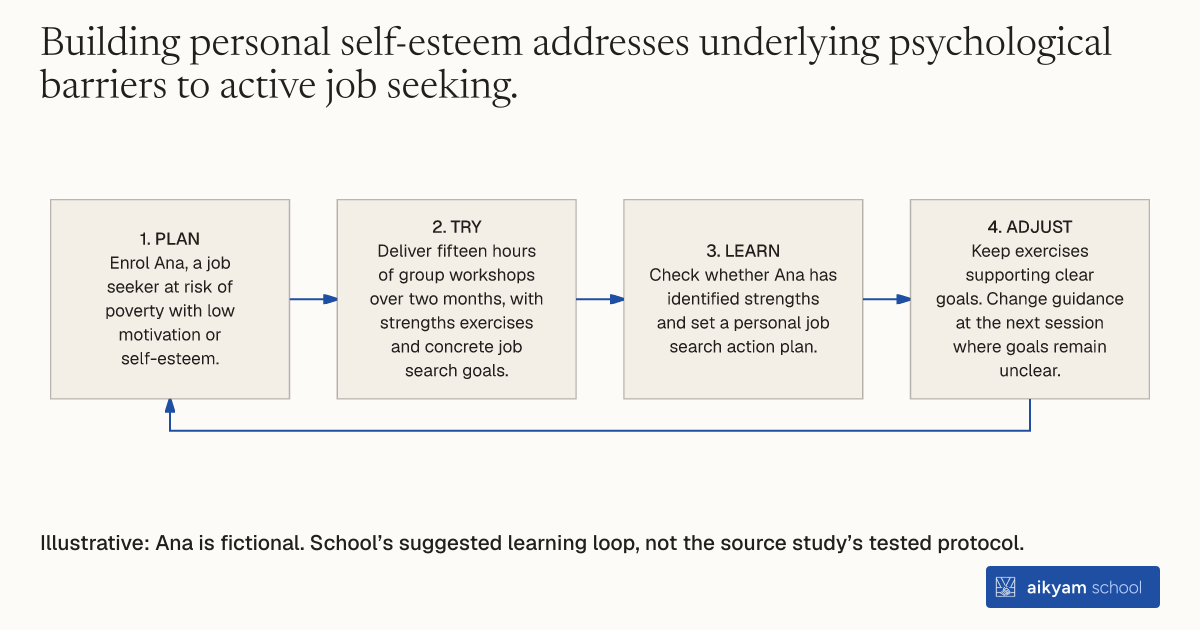
- Plan: Enrol Ana, a job seeker at risk of poverty with low motivation or self-esteem.
- Try: Deliver fifteen hours of group workshops over two months, with strengths exercises and concrete job search goals.
- Learn: Check whether Ana has identified strengths and set a personal job search action plan.
- Adjust: Keep exercises supporting clear goals. Change guidance at the next session where goals remain unclear.
Illustrative: Ana is fictional. School’s suggested learning loop, not the source study’s tested protocol.
See source →School’s suggested, untested loop: observe strengths exercises and action plans; the trial did not increase short-term employment probability.
How
When to use
Vulnerable job seekers at risk of social exclusion often suffer from low self-esteem and low motivation. Standard job search programs fail when participants lack confidence in their ability to secure work. This method delivers short personal empowerment workshops to strengthen job search motivation and proactivity among low-income job seekers.
Deliver short group empowerment workshops focused on building self-esteem and active job search motivation.
- Social caseworkers identify job seekers at risk of poverty who display low motivation or low self-esteem.
- Facilitators conduct fifteen hours of group workshops over two months focused on personal strengths and emotional resilience.
- Instructors lead interactive exercises to build participant self-confidence and self-awareness.
- Advisors assist participants in setting concrete active job search goals and personal action plans.
Why it works
Strengthening emotional resilience encourages participants to adopt proactive mindsets and maintain job search efforts.
Example
The Ayuntamiento de Santander in Cantabria, Spain provided fifteen hours of empowerment workshops to job seekers across 327 families at risk of poverty. Participating job seekers completed group motivation and resilience activities over two months. The intervention improved participants' overall job search behaviors, attitudes, motivation, and proactivity.
About the study
Participants
365 working-age individuals in 327 families at risk of poverty in Santander, Spain.
Study Design
Randomised Controlled Trial (RCT) evaluating 15 hours of personal empowerment workshops delivered over 2 months.
Results
The workshops enhanced overall job search behaviours and attitudes, motivation, and proactivity in the job search, but did not increase short-term employment probability.