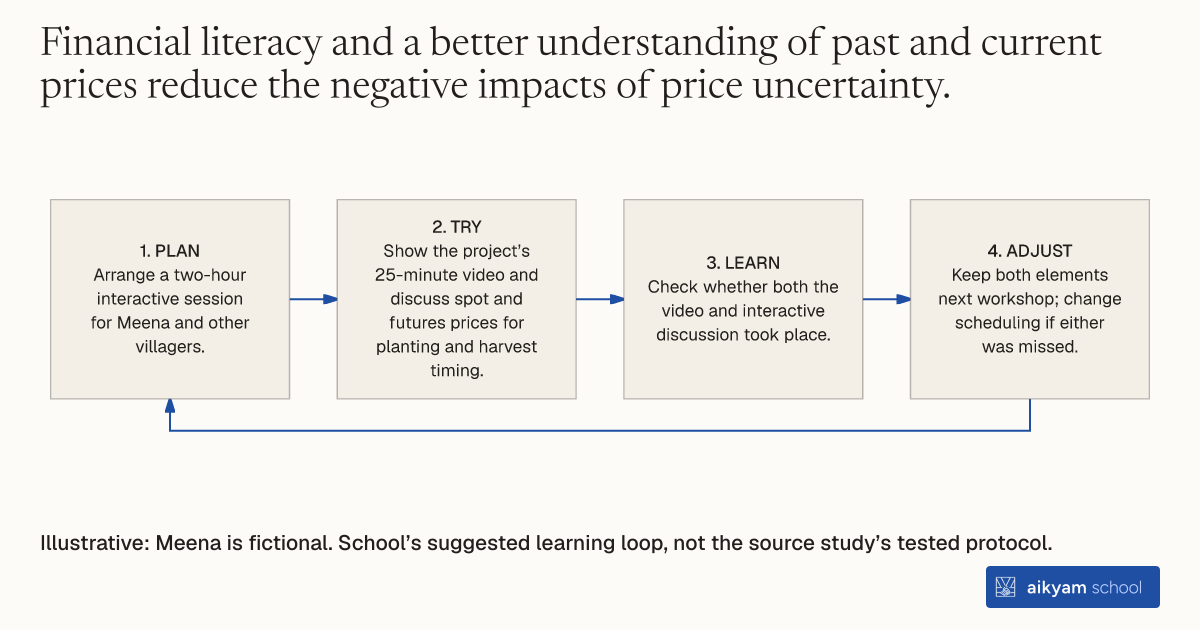
Try, learn and adjust
Check the futures workshop includes video and discussion
- Plan: Arrange a two-hour interactive session for Meena and other villagers.
- Try: Show the project’s 25-minute video and discuss spot and futures prices for planting and harvest timing.
- Learn: Check whether both the video and interactive discussion took place.
- Adjust: Keep both elements next workshop; change scheduling if either was missed.
Illustrative: Meena is fictional. School’s suggested learning loop, not the source study’s tested protocol.
See source →Workshop length and delivery of both elements. The evaluation is ongoing; no effects are reported. School’s suggested learning loop, not a source-tested cycle.
How
When to use
Smallholder farmers face severe price uncertainty and lack understanding of price signals. Raw market price data fails to help producers who cannot interpret futures contracts. This training teaches rural villagers how to use futures prices for financial risk management.
Train villagers to understand and use futures market prices through an interactive video session.
- Project staff produce a twenty-five minute educational video explaining futures prices.
- Trainers organize a two-hour interactive training workshop for villagers in target communities.
- Facilitators present the twenty-five minute educational video during the meeting.
- Instructors lead interactive discussions on applying spot and futures prices to planting decisions and harvest timing.
Why it works
Combining futures market price discovery with spot prices empowers farmers to make informed decisions and reduce economic risk.
Example
Researchers from J-PAL, SEWA, and CMF delivered a two-hour interactive training session featuring a twenty-five minute video to farmers in Gujarat, India.
About the study
Participants
Farmers across 108 villages in 4 districts of Gujarat, India.
Study Design
Randomized evaluation conducted by J-PAL researchers in partnership with SEWA and CMF.
Results
Study ongoing; results forthcoming.