In Simple Words
Reading a physics textbook about swimming rarely motivates someone to jump into a deep pool. However, watching a short video of a neighbor from the same street who learned to swim and navigate deep waters provides both a practical blueprint and the personal confidence to jump in.
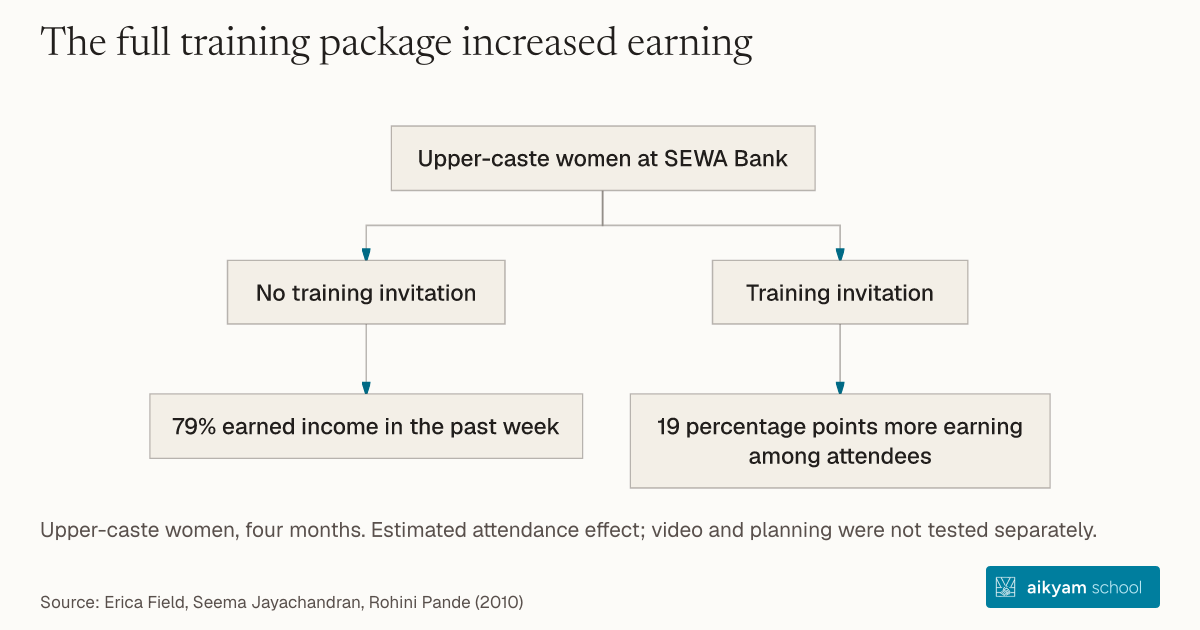
Upper-caste women at SEWA Bank
- No training invitation
- 79% earned income in the past week
- Training invitation
- 19 percentage points more earning among attendees
Four-month full-program result among upper-caste women. The film and goal-setting elements were not tested separately; randomized invitations identify the attendance effect.
See source →Research question
Standard financial literacy curricula focus exclusively on mechanical accounting techniques, failing to elevate business aspirations or drive active behavioral changes among poor micro-entrepreneurs. Integrating relatable peer role models into training bridges the gap between abstract financial knowledge and concrete business expansion.
Participants
N = 289 treated female micro-entrepreneurs in 57 training session clusters in Ahmedabad, India.
Study Design
RCT testing a streamlined 2-day business module combining financial accounting with a peer success documentary film and a 6-month financial goal decomposition worksheet.
Results
Combining peer video motivation with concrete goal-setting generated a 19 percentage point increase in labor market participation (p < 0.01) and a 17 percentage point increase in business discussions with family (p < 0.05) among moderately restricted women.
Takeaway
Embed short documentary films showcasing local peer role models alongside goal-setting exercises into micro-business training programs to elevate aspirations and active decision-making.
Source and citation
See source →Read alongside the research
Plain-English glossary
Original explanations, informed by the references below. Examples are illustrations, not data from the studies above. The research text stays unchanged.
- Percentage points
The difference between two percentages.
ExampleA rise from 40% to 50% is 10 percentage points. Relative to the starting value, that is a 25% increase.
Office for National Statistics · Percentages ↗Read more about percentage points →- Randomized controlled trial
A study that uses chance, like drawing lots, to decide who receives each option being compared. Researchers compare the groups’ outcomes to estimate the effect of those options.
ExampleA lottery assigns volunteers to a training programme or a comparison group. Researchers then compare their outcomes.
GET-IT glossary · Randomized study ↗Read more about randomized controlled trial →