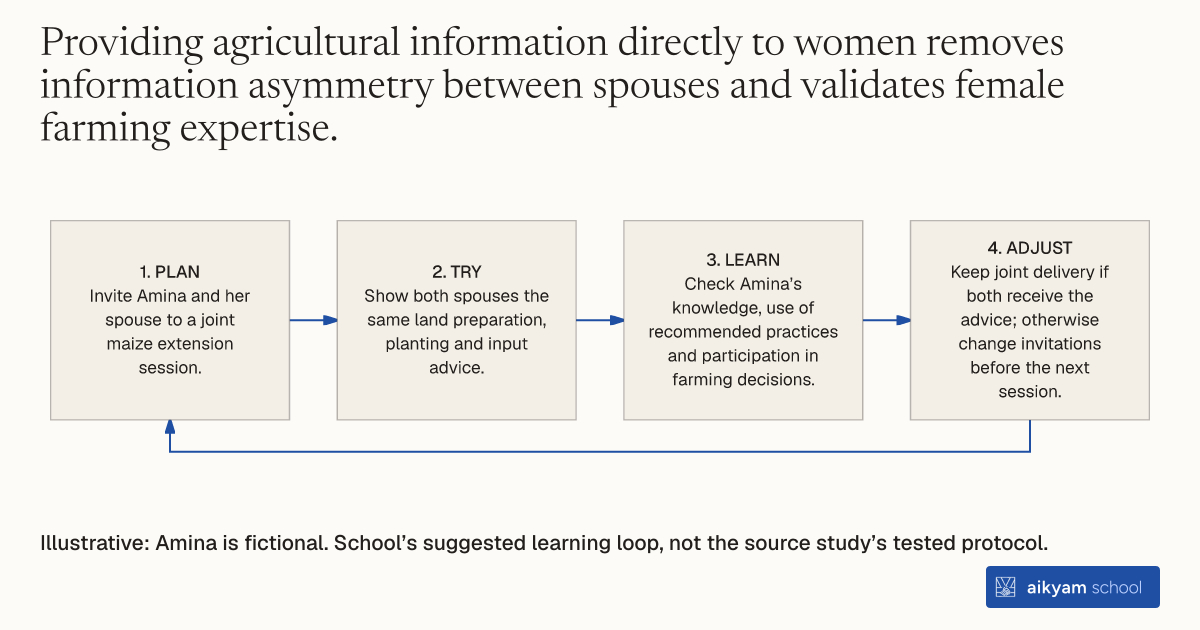
Try, learn and adjust
Check whether both spouses receive maize advice
- Plan: Invite Amina and her spouse to a joint maize extension session.
- Try: Show both spouses the same land preparation, planting and input advice.
- Learn: Check Amina’s knowledge, use of recommended practices and participation in farming decisions.
- Adjust: Keep joint delivery if both receive the advice; otherwise change invitations before the next session.
Illustrative: Amina is fictional. School’s suggested learning loop, not the source study’s tested protocol.
See source →Observe both spouses’ access to advice and women’s practice adoption and decision-making. School suggests this learning loop; it was not tested by the source.
How
When to use
Women farmers are frequently excluded from traditional agricultural extension programs because advisory services target male heads of household. Excluding women limits their knowledge of improved farming practices and reduces their decision-making authority within farming households. This method delivers agricultural advisory information to both male and female household members to improve technology adoption and agricultural knowledge.
Deliver instructional video extension modules to both male and female spouses together within farming households.
- Extension officers identify target maize-farming households in rural communities.
- Field staff invite both male and female spouses to attend household extension sessions.
- Extension workers play instructional video modules demonstrating improved maize management practices for both spouses.
- Spouses observe recommended land preparation, planting, and input application techniques together.
- Female members apply the recommended practices on household farm plots and participate in farming decisions.
Why it works
Joint exposure encourages intra-household communication and enables women to exercise greater decision-making authority.
Example
In Uganda, maize-farming households were shown an instructional video on improved maize management practices delivered either to the male member, the female member, or both spouses as a couple. Involving women increased their knowledge and adoption of recommended practices by 13 percentage points relative to male-only targeting.
About the study
Participants
Smallholder maize-farming households in rural Uganda.
Study Design
Randomized evaluation comparing agricultural knowledge, technology adoption, and decision-making power across households where extension videos were shown to male members only, female members only, or both spouses as a couple.
Results
Involving women as information recipients improved their knowledge and adoption of recommended practices by 13 percentage points relative to male-only information delivery (an increase of about 267 percent), while providing information to female members alone increased female agricultural decision-making power.