Research steps
Build monthly spending per household member
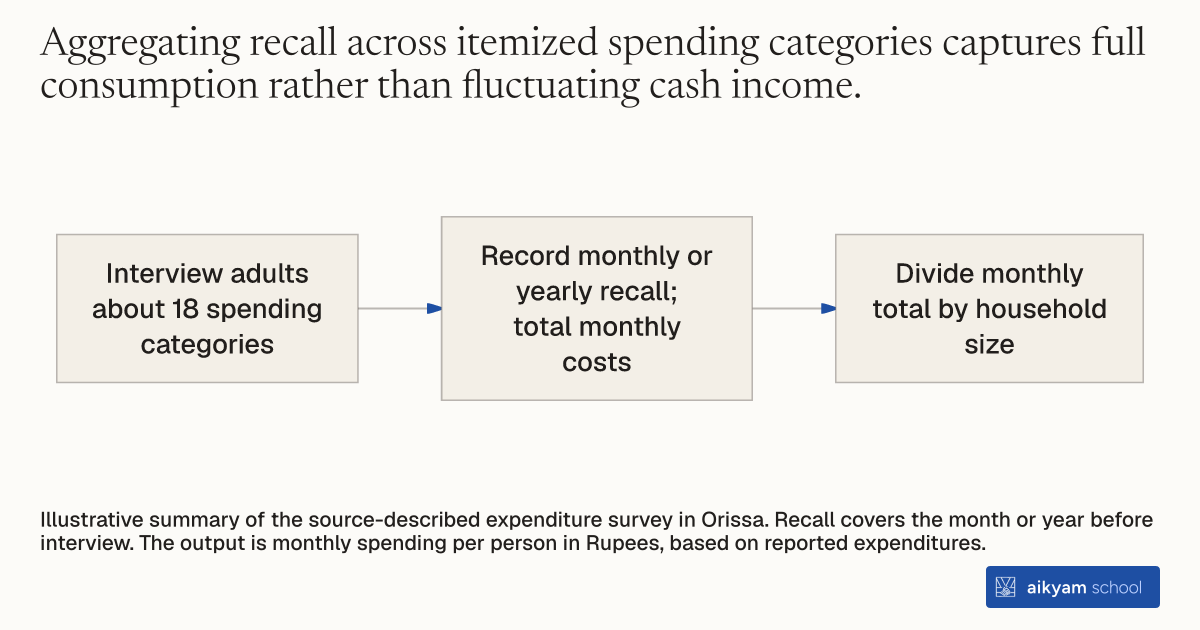
- Interview adults about 18 spending categories
- Record monthly or yearly recall; total monthly costs
- Divide monthly total by household size
Illustrative summary of the source-described expenditure survey in Orissa. Recall covers the month or year before interview. The output is monthly spending per person in Rupees, based on reported expenditures.
See source →How
When to use
Researchers and evaluators in developing regions face inaccurate income reporting due to informal and seasonal earnings. Direct income questions frequently underestimate household resources and fail to capture living standards. Aggregating itemized spending across specific expenditure categories provides a reliable proxy for household consumption and economic well-being.
Measure household economic status by administering an itemized survey that collects expenditures across distinct consumption categories.
- Train field enumerators to interview adult respondents during household baseline survey visits.
- Prompt respondents to recall household expenditures across 18 distinct item categories.
- Record spending for short-term and long-term consumption categories over the month or year before the interview.
- Sum reported expenditures across all 18 categories to compute total household monthly expenditure.
- Divide total monthly expenditure by household size to calculate monthly per capita expenditure in Rupees.
Why it works
Per capita expenditure calculations allow researchers to benchmark household living standards against official poverty lines.
Example
Surveyors interviewed adult respondents across 1,947 households in 150 rural villages in Orissa, India, in May–June 2007. The itemized survey established a mean monthly per capita expenditure of Rs 655, approximately double the rural Orissa poverty line of Rs 326.
About the study
Participants
1,947 households with 10,641 members in 150 villages across Bargarh, Balangir, Kandhamal, Keonjhar, and Sambalpur districts in Orissa, India, where over 90 percent belong to Scheduled Castes, Scheduled Tribes, or Other Backward Castes.
Study Design
Survey monitors administered a baseline questionnaire to adult respondents eliciting expenditure across 18 itemized categories over the month or year preceding the interview to construct per capita consumption measures.
Results
Mean monthly per capita expenditure was Rs 655 (standard deviation 443) with log per capita expenditure averaging 6.32 (standard deviation 0.56), compared to the 2004–05 rural Orissa poverty line of Rs 326 per person per month.