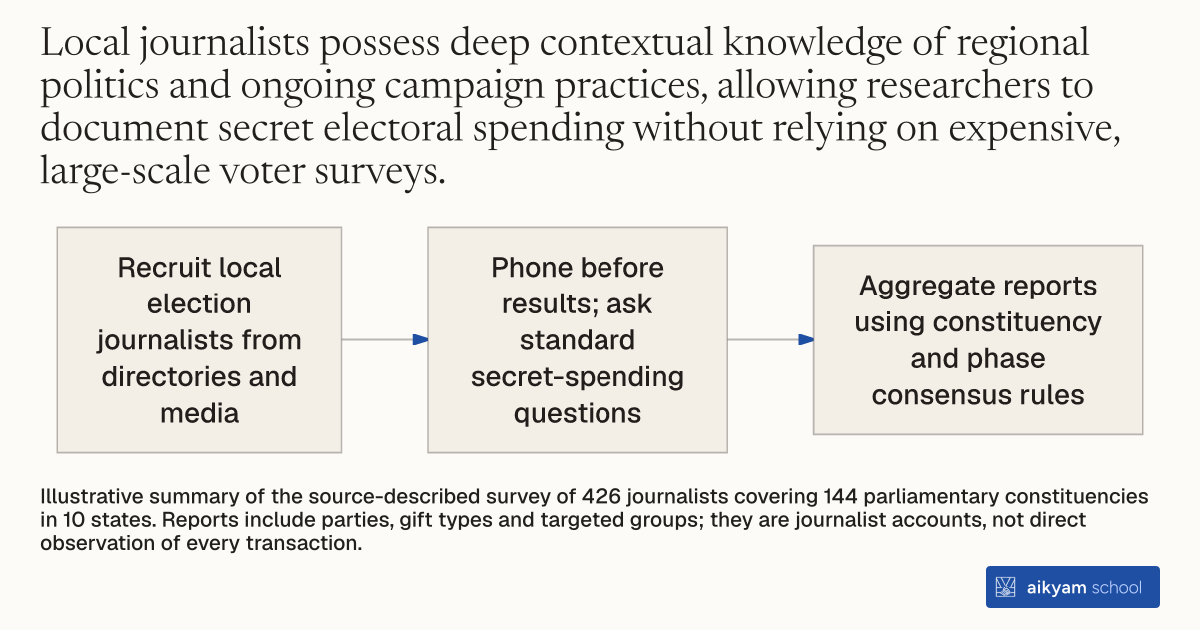
Research steps
Record journalists’ reports of vote buying
- Recruit local election journalists from directories and media
- Phone before results; ask standard secret-spending questions
- Aggregate reports using constituency and phase consensus rules
Illustrative summary of the source-described survey of 426 journalists covering 144 parliamentary constituencies in 10 states. Reports include parties, gift types and targeted groups; they are journalist accounts, not direct observation of every transaction.
See source →How
When to use
In developing democracies, vote buying is an illegal transaction between bribe givers and takers that is rarely observed directly or recorded in official data. Evaluators and researchers need spatial data to identify which political parties engage in secret electoral spending across different constituencies. Conducting standardized phone surveys with local journalists provides a cost-effective method to classify corrupt party behavior before election results are released.
Conduct phone interviews with local journalists covering specific electoral constituencies using a standardized questionnaire to identify parties engaging in illicit secret spending.
- Assemble a sample of journalists covering local parliamentary constituencies from registered reporter directories, national news outlets, and regional media organizations.
- Contact journalists by phone prior to the release of election results and administer a standardized set of questions about their designated electoral districts.
- Ask respondents to identify which specific political parties spend the most money secretly, such as on cash, liquor, or gifts.
- Record details on the types of bribes distributed and the demographic groups targeted by candidates.
- Aggregate journalist responses across constituency and state-election phase levels to code vote-buying party status under multiple strict consensus thresholds.
Why it works
Aggregating responses across multiple reporters and geographic levels minimizes reporting errors and provides reliable indicators of party malpractice.
Example
Researchers interviewed 426 journalists covering 144 parliamentary constituencies across 10 Indian states during the 2014 general elections. The survey identified vote-buying parties in 138 constituencies, revealing that 82 percent of respondents observed secret spending, primarily involving cash (82 percent), liquor (28 percent), and food (15 percent).
About the study
Participants
The survey interviewed 426 journalists covering 144 parliamentary constituencies across 10 Indian states representing 67 percent of the national population. In 83 percent of constituencies with two respondents, both agreed on at least one vote-buying party, and in 97 percent of constituencies with three respondents, at least two agreed.
Study Design
Researchers drew journalists from registered reporter directories and snowball sampling across English, Hindi, and regional media, administering standardized phone questionnaires before election results were released. Party malpractice was coded using four distinct specifications at the parliamentary constituency and state-election phase levels to evaluate treatment effects in an RCT covering 615 assembly constituencies.
Results
Eighty-two percent of interviewed journalists identified at least one vote-buying party in their assigned constituency. Among journalists reporting gift types, cash was identified by 82 percent, liquor by 28 percent, and food by 15 percent, with lower castes and religious minorities identified as the primary target group by 40 percent of respondents.