Try, learn and adjust
Check the initial retailer discount reaches stock
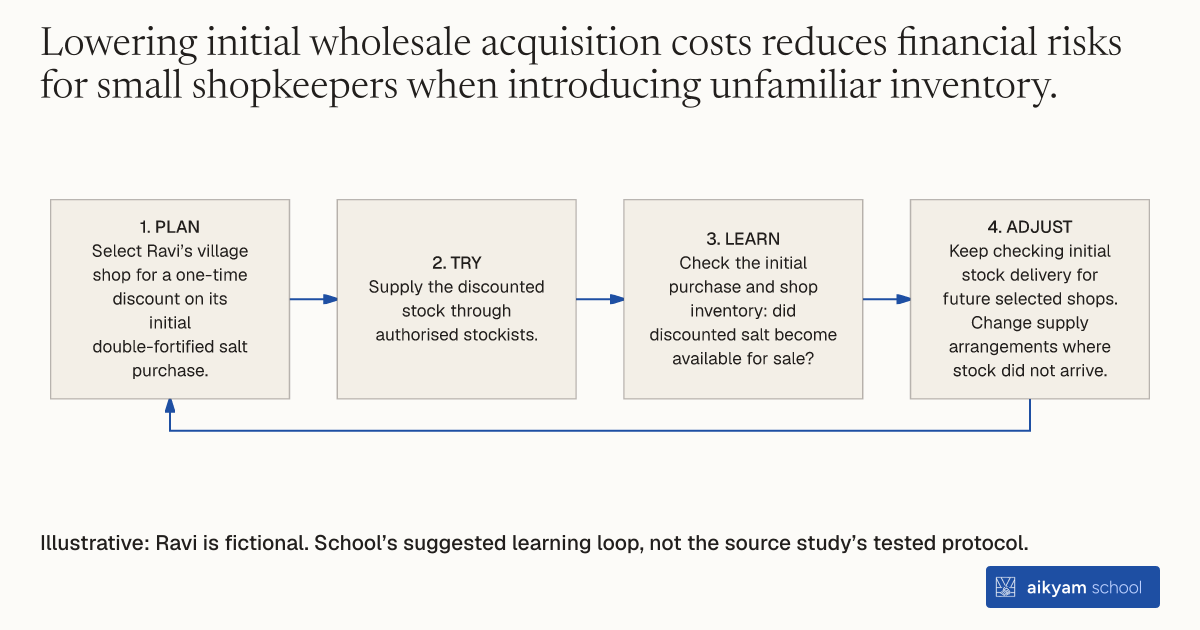
- Plan: Select Ravi’s village shop for a one-time discount on its initial double-fortified salt purchase.
- Try: Supply the discounted stock through authorised stockists.
- Learn: Check the initial purchase and shop inventory: did discounted salt become available for sale?
- Adjust: Keep checking initial stock delivery for future selected shops. Change supply arrangements where stock did not arrive.
Illustrative: Ravi is fictional. School’s suggested learning loop, not the source study’s tested protocol.
See source →School’s suggested, untested loop. Observe the initial discount, stocking and availability. The discount is one-time; do not infer health effects.
How
When to use
In rural areas, local shopkeepers may hesitate to stock a new food fortification product if wholesale purchase costs appear risky or uncertain. Store owners may prioritize familiar brands over unfamiliar micronutrient-fortified items. Offering a one-time wholesale discount to selected village retailers reduces initial stock purchasing risks and encourages grocers to carry fortified salt.
Provide a temporary price discount on wholesale inventory purchases to incentivize village retailers to stock new health products.
- Identify kirana grocery stores and Public Distribution System shops operating within targeted sales villages.
- Select a targeted subset of local retailers to receive promotional wholesale pricing.
- Offer selected retailers a one-time price discount on their initial bulk purchase of double-fortified salt packets.
- Supply the discounted inventory through authorized distribution stockists.
- Monitor initial shop stocking and retail product availability across participating village stores.
Why it works
This encourages store owners to purchase initial stock and offer the fortified product to local village consumers.
Example
As part of a randomized social marketing experiment across 200 sales villages in Bhojpur district, Bihar, field teams offered a one-time discount to a set of chosen retailers stocking double-fortified salt.
About the study
Participants
Sub-experiment across 200 sales villages in Bhojpur district, Bihar, evaluating household adoption in communities with a 45 percent baseline anemia rate.
Study Design
Cross-randomized marketing trial embedded within a cluster randomized trial where a one-time wholesale price discount was randomly assigned to selected retailers in sales villages.
Results
Social marketing interventions including retailer discounts were evaluated for take-up effects, but sales village interventions produced no statistically significant increase in overall population hemoglobin (0.033 g/dL, 95% CI: -0.024 to +0.09 g/dL) or reduction in anemia (-0.6 percentage points).