Try, learn and adjust
Track credit use after flood-tolerant seed access
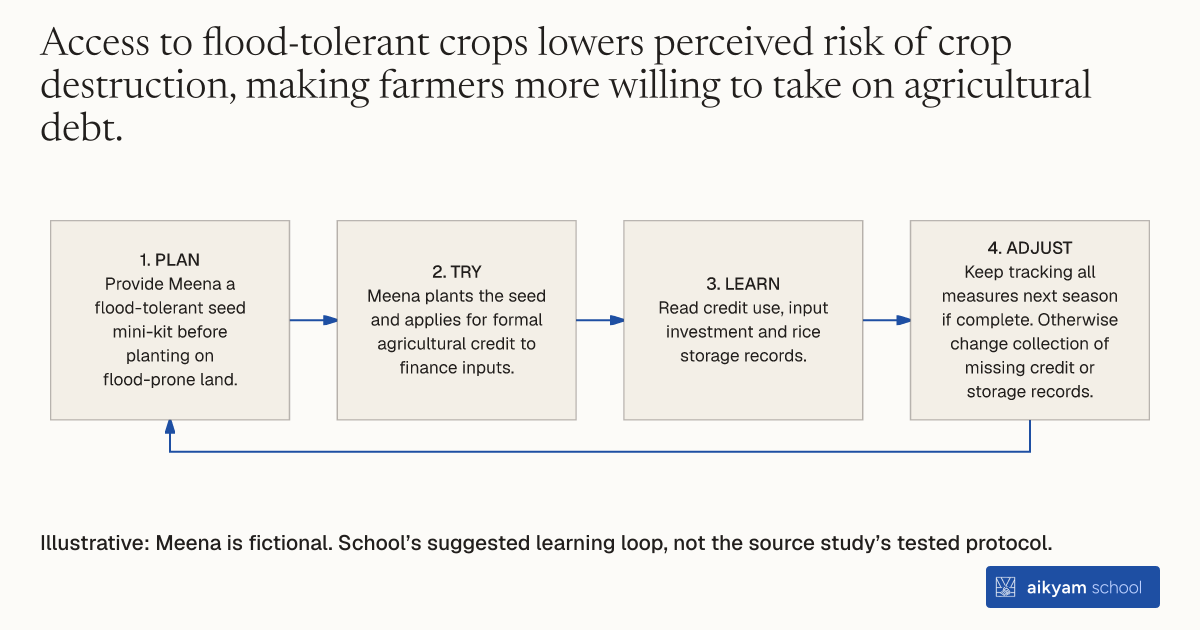
- Plan: Provide Meena a flood-tolerant seed mini-kit before planting on flood-prone land.
- Try: Meena plants the seed and applies for formal agricultural credit to finance inputs.
- Learn: Read credit use, input investment and rice storage records.
- Adjust: Keep tracking all measures next season if complete. Otherwise change collection of missing credit or storage records.
Illustrative: Meena is fictional. School’s suggested learning loop, not the source study’s tested protocol.
See source →School’s suggested learning loop: observe borrowing, farm inputs and precautionary grain storage. Do not assume that planting guarantees a loan or that storage falls for every farmer.
How
When to use
Smallholder farmers in flood-prone regions struggle to secure formal agricultural credit due to unpredictable weather risks. Unhedged flood risks cause lenders to ration credit and force farmers to rely on conservative self-insurance. Mitigating weather risks with stress-tolerant seeds allows farmers to access formal credit products and fund productive farm investments.
Expand smallholder access to formal agricultural credit by using risk-reducing seed varieties as a buffer against flood default.
- Extension agencies distribute flood-tolerant seed mini-kits to smallholder farmers in flood-prone agricultural villages.
- Farmers plant stress-tolerant seeds on their plots to protect crop yields against flood submergence.
- Farmers apply for formal agricultural credit products to finance inputs such as fertilizer and labor.
- Financial institutions disburse loan capital to farmers whose downside harvest risk is mitigated by stress-tolerant crops.
- Farmers reduce precautionary grain storage by roughly 150 kg and direct borrowed funds toward productive agricultural investments.
Why it works
Mitigating downside risk provides greater financial stability and replaces conservative self-insurance with productive financial investment.
Example
Researchers evaluated borrowing and savings decisions among smallholders in Bhadrak and Balasore districts, Odisha, India. Access to Swarna-Sub1 increased the probability of using formal agricultural credit by 6.8 percentage points (a 36 percent increase) and decreased precautionary household rice storage by roughly 150 kg.
About the study
Participants
128 flood-prone villages in Bhadrak and Balasore districts, Odisha, India; 1,280 smallholder households; 56 percent lived below the poverty line and owned 0.84 hectares of land on average.
Study Design
Two-year randomized controlled trial measuring household credit adoption and precautionary rice savings across treatment and control groups over flood (2011–2012) and non-flood (2012–2013) growing seasons.
Results
Swarna-Sub1 adoption increased the probability of using agricultural credit products by 6.8 percentage points (a 36 percent increase from a baseline of 19 percent) and decreased precautionary rice storage by roughly 150 kg from a base of 1,711 kg.