Try, learn and adjust
Check cost recovery and service reach
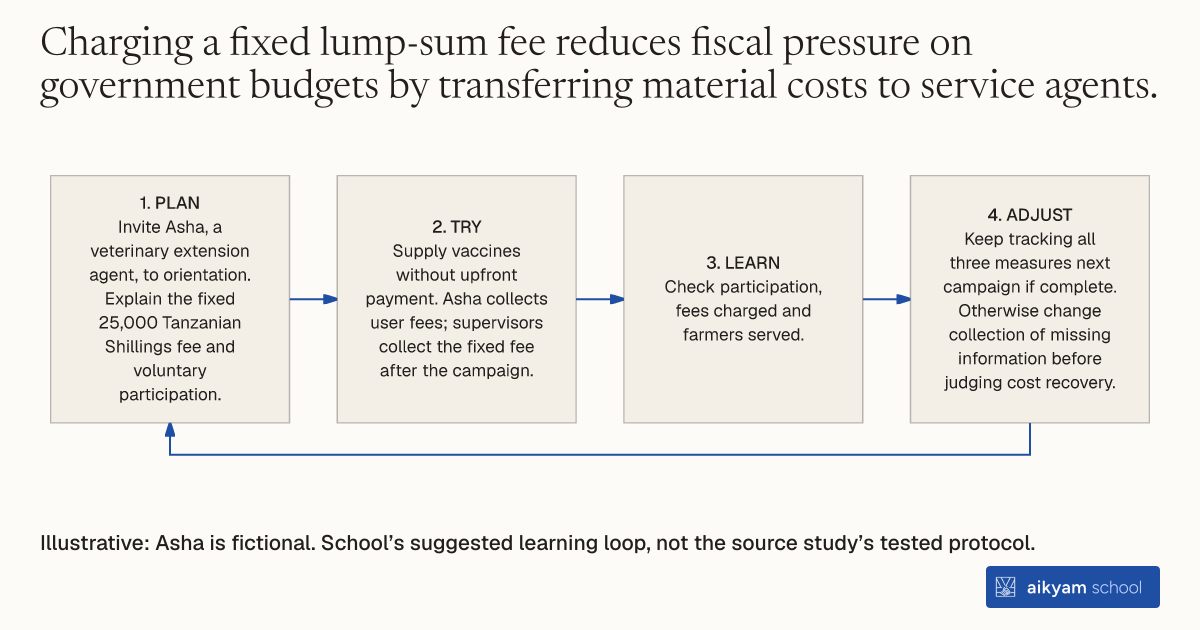
- Plan: Invite Asha, a veterinary extension agent, to orientation. Explain the fixed 25,000 Tanzanian Shillings fee and voluntary participation.
- Try: Supply vaccines without upfront payment. Asha collects user fees; supervisors collect the fixed fee after the campaign.
- Learn: Check participation, fees charged and farmers served.
- Adjust: Keep tracking all three measures next campaign if complete. Otherwise change collection of missing information before judging cost recovery.
Illustrative: Asha is fictional. School’s suggested learning loop, not the source study’s tested protocol.
See source →School’s suggested learning loop, not the source’s tested procedure. Observe participation, user prices and farmers served. The source reports higher prices and fewer farmers served; unchanged participation alone does not show unchanged access.
How
When to use
Public agencies face severe fiscal budget constraints when subsidising input supplies for frontline service campaigns. Requiring service providers to pay a fixed participation fee passes production costs to decentralised workers. This method applies when governments want to recover program expenses while granting agents freedom to recoup costs through user fees.
Require frontline service delivery agents to contribute a fixed lump-sum participation fee to cover material production costs.
- Ministry staff invite local public service agents to a district orientation meeting before the delivery campaign begins.
- Officials inform participants that accepting campaign supplies requires a fixed lump-sum participation payment to cover production costs.
- Supervisors allow agents to accept or reject participation without penalty or immediate upfront cash payment.
- Participating agents deliver services to local recipients and collect user fees to cover their operating expenses and the participation fee.
- Local government supervisors collect the fixed participation fee from agents after the service campaign ends.
Why it works
Because agents set consumer prices based on average operating costs rather than marginal costs, they raise unit user fees to recover the fixed fee.
Example
The Ministry of Agriculture, Livestock and Fisheries in Tanzania required 210 veterinary extension agents across 136 administrative wards to contribute a fixed participation fee of 25,000 Tanzanian Shillings to receive poultry vaccines. Agents paid the fee after completing a 3-week vaccination campaign funded by farmer user charges. Participating agents raised average user prices by 11% to cover the fee, allowing the government to recover costs without reducing total program participation.
About the study
Participants
832 frontline government veterinary extension agents across 550 administrative wards in 27 districts of Tanzania (Dodoma, Iringa, Morogoro, and Tanga regions).
Study Design
Randomized controlled trial assigning agents in 273 wards to pay a 25,000 Tanzanian Shillings participation fee collected after campaign completion, compared against 277 control wards receiving free vaccine supplies.
Results
Imposing the lump-sum participation fee increased average per-unit prices charged to farmers by 11.1% (7.155 Tanzanian Shillings increase, p < 0.05). The price increase reduced the average number of farmers served per agent by 12% (6.69 fewer farmers, p < 0.10), while total agent revenue showed no statistically significant change (-0.4%, p > 0.10). Program participation rates remained unchanged at 82% across treatment and control groups (p > 0.10).