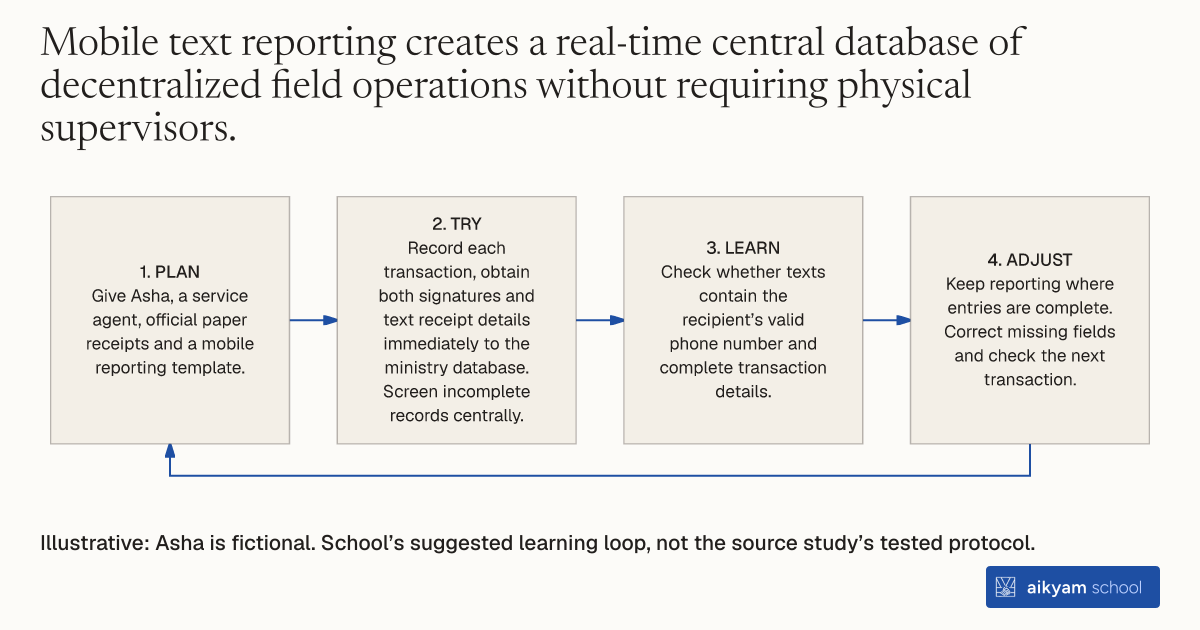
Try, learn and adjust
Check receipt texts reach the central database
- Plan: Give Asha, a service agent, official paper receipts and a mobile reporting template.
- Try: Record each transaction, obtain both signatures and text receipt details immediately to the ministry database. Screen incomplete records centrally.
- Learn: Check whether texts contain the recipient’s valid phone number and complete transaction details.
- Adjust: Keep reporting where entries are complete. Correct missing fields and check the next transaction.
Illustrative: Asha is fictional. School’s suggested learning loop, not the source study’s tested protocol.
See source →School’s suggested, untested loop: observe receipt details, customer phone numbers and SMS submission; reporting alone does not verify service delivery.
How
When to use
Central government supervisors struggle to monitor public service transactions in remote rural areas without physical oversight. Decentralized workers often fail to report complete sales figures or recipient details to central managers. Collecting transaction data via text messages creates an immediate electronic record of decentralized public service delivery.
Mandate mobile text-message transmission of transaction details to a central database immediately after issuing official service receipts.
- Provide service delivery agents with official paper receipts and mobile phone reporting templates before a campaign starts.
- Instruct agents to fill out a paper receipt for every customer, recording recipient name, contact phone number, village name, visit date, total fee, and units served.
- Require customers and service agents to sign the paper receipt to confirm transaction accuracy.
- Direct agents to transmit the receipt details to the central ministry database using a mobile text message immediately after service delivery.
- Filter incoming text messages at central headquarters to screen out incomplete records lacking valid customer phone numbers.
Why it works
Requiring valid customer contact numbers allows central managers to conduct remote verification audits.
Example
The Ministry of Agriculture, Livestock and Fisheries in Tanzania required 832 livestock extension agents to text receipt data to a central database during a 3-week poultry vaccination campaign. Agents submitted 31,657 valid text-message receipts covering 702,762 vaccinated animals across 550 administrative wards. Less than 4% of receipts were rejected for missing contact phone numbers.
About the study
Participants
832 frontline government extension agents across 550 administrative wards in 27 districts of Tanzania (Dodoma, Iringa, Morogoro, and Tanga regions).
Study Design
Randomized field trial evaluating electronic SMS transaction reporting mandatory for bonus eligibility, tracking receipt submissions across a 3-week campaign.
Results
Extension agents submitted 31,657 valid text-message receipts covering 702,762 vaccinated animals. Less than 4% of receipts were submitted without recipient phone numbers. Mandatory SMS reporting enabled central administrators to conduct random phone verification surveys on 4,516 sampled receipts, reaching 3,580 farmers and verifying 69% of reported transactions.