Research steps
Measure time use and well-being
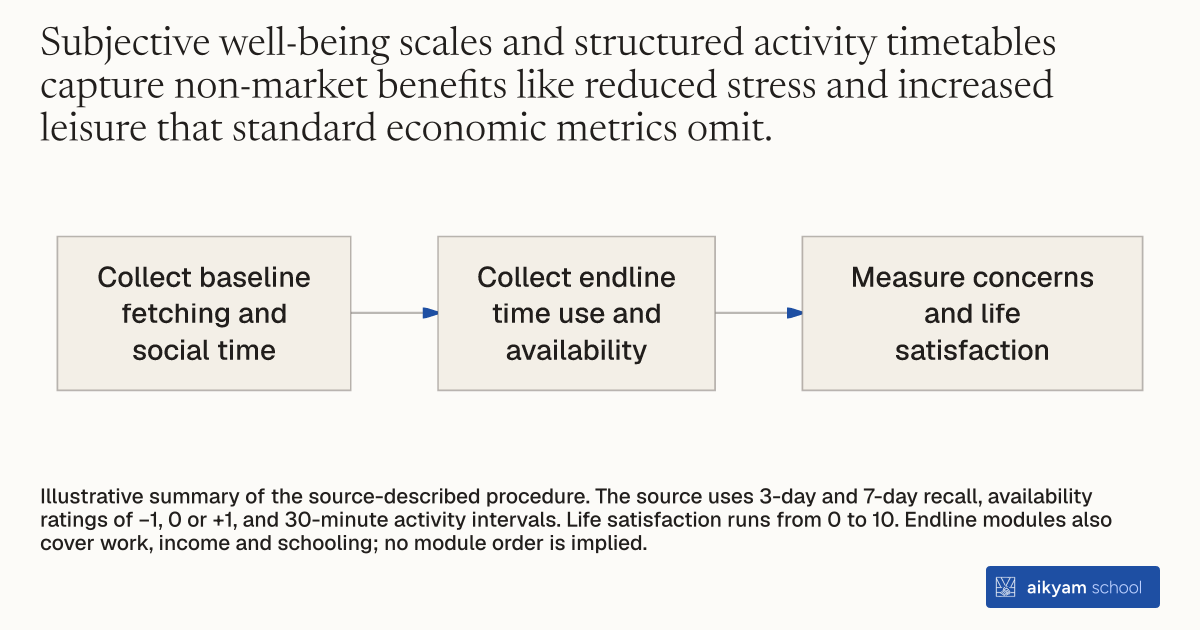
- Collect baseline fetching and social time
- Collect endline time use and availability
- Measure concerns and life satisfaction
Illustrative summary of the source-described procedure. The source uses 3-day and 7-day recall, availability ratings of −1, 0 or +1, and 30-minute activity intervals. Life satisfaction runs from 0 to 10. Endline modules also cover work, income and schooling; no module order is implied.
See source →How
When to use
Infrastructure evaluations often focus narrowly on physical health or market labor, missing psychological and daily life improvements. This method measures changes in time allocation, social interactions, and subjective quality of life through comprehensive household surveys. It enables evaluators to capture non-monetary welfare gains among low-income households gaining private utility services.
Measure well-being and daily time use by combining structured recall surveys, time availability ratings, and 24-hour activity timetables administered to household members.
- Administer a baseline survey collecting 3-day and 7-day recall data on water fetching trips, fetching duration, and socializing time during collection.
- Ask respondents at endline to rate perceived changes in time availability across daily tasks and social engagements on a three-point scale (-1 for less, 0 for same, +1 for more).
- Administer a 24-hour recall activity timetable recording the number of 30-minute intervals spent on eight specific leisure activities over the past 7 days.
- Survey household members on labor market participation, income generated over the past 30 days, and child school completion.
- Prompt respondents to list their top five major sources of concern to measure water-related worry.
- Evaluate overall life satisfaction on a 0 to 10 scale and measure mental well-being over the past seven days using sadness, worry, and satisfaction indicators.
Why it works
Gathering both perceived and recalled time metrics provides a validated, multi-dimensional view of how utility access transforms daily living conditions.
Example
In Tangiers, Morocco, enumerators administered baseline and endline surveys to 793 resurveyed households to evaluate the impacts of home water connections. Getting connected reduced water-fetching time from 82 to 0 minutes in 3 days, increased reported household life improvement by 21 percentage points (from 23 to 44 percent), and reduced households listing water as a major concern from 66 percent to 0 percent (IV estimate).
About the study
Participants
793 resurveyed low-income households in Tangiers, Morocco (94 percent follow-up rate).
Study Design
Baseline and 6-month endline structured household surveys using instrumental variable estimation to evaluate time use, time availability, leisure timetables, and life satisfaction metrics.
Results
Piped connections eliminated water fetching time (saving 82 minutes per 3 days), increased overall life satisfaction scores of 5 or higher by 6 percentage points (from 69 percent base), and increased reported life improvement by 21 percentage points without impacting labor force participation or income.