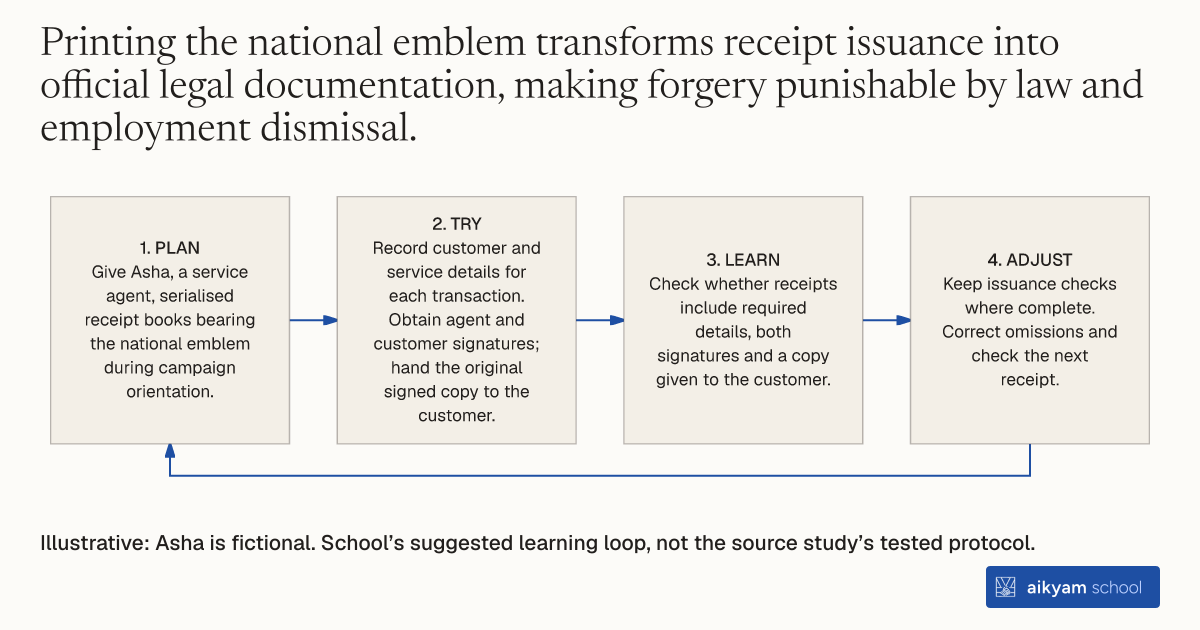
Try, learn and adjust
Check official receipts are complete and signed
- Plan: Give Asha, a service agent, serialised receipt books bearing the national emblem during campaign orientation.
- Try: Record customer and service details for each transaction. Obtain agent and customer signatures; hand the original signed copy to the customer.
- Learn: Check whether receipts include required details, both signatures and a copy given to the customer.
- Adjust: Keep issuance checks where complete. Correct omissions and check the next receipt.
Illustrative: Asha is fictional. School’s suggested learning loop, not the source study’s tested protocol.
See source →School’s suggested, untested loop: observe serial numbers, emblem, transaction details, signatures and customer copies.
How
When to use
Frontline public workers delivering decentralized services can overcharge customers or fabricate transaction reports. Standard unadorned paper receipts are easily forged or ignored by service providers. Printing official government national emblems on serialized paper receipts transforms receipt issuance into a legal contract that deters worker fraud and price-cap violations.
Issue official paper receipts bearing national government emblems to document every decentralized customer transaction.
- Ministry staff print serialized paper receipt books featuring the official national emblem of the government.
- District training officers distribute receipt books to frontline service delivery agents during campaign orientation meetings.
- Service delivery agents complete a paper receipt for every customer served, filling in the recipient name, phone number, village name, date, user fee charged, and quantity delivered.
- Service delivery agents sign the receipt to certify transaction accuracy under legal penalty.
- Customers sign the receipt to confirm service delivery and fee payment.
- Service delivery agents hand the original signed paper receipt copy directly to the customer.
Why it works
Requiring mutual signatures deters workers from misrepresenting prices or fabricating transactions.
Example
The Ministry of Agriculture, Livestock and Fisheries in Tanzania distributed official paper receipts bearing the national emblem to 832 livestock extension agents across 550 administrative wards. Agents issued receipts to farmers for 31,657 transactions during a 3-week vaccination campaign, maintaining a 69% verification rate and limiting price-cap non-compliance to 4.5%.
About the study
Participants
832 frontline government extension agents and 3,580 verified smallholder farmers across 550 administrative wards in 27 districts of Tanzania.
Study Design
Field experimental evaluation requiring official national emblem paper receipt issuance for every transaction, verified via electronic SMS logs and a 15% random phone survey of recipients.
Results
Extension agents issued 31,657 official emblem receipts covering 702,762 livestock vaccinations. Random phone verification surveys reached 3,580 farmers and confirmed that 69% of reported paper receipts were fully verifiable, while detecting only 4.5% non-compliance with the 80 Tanzanian Shilling price cap in the treatment group.