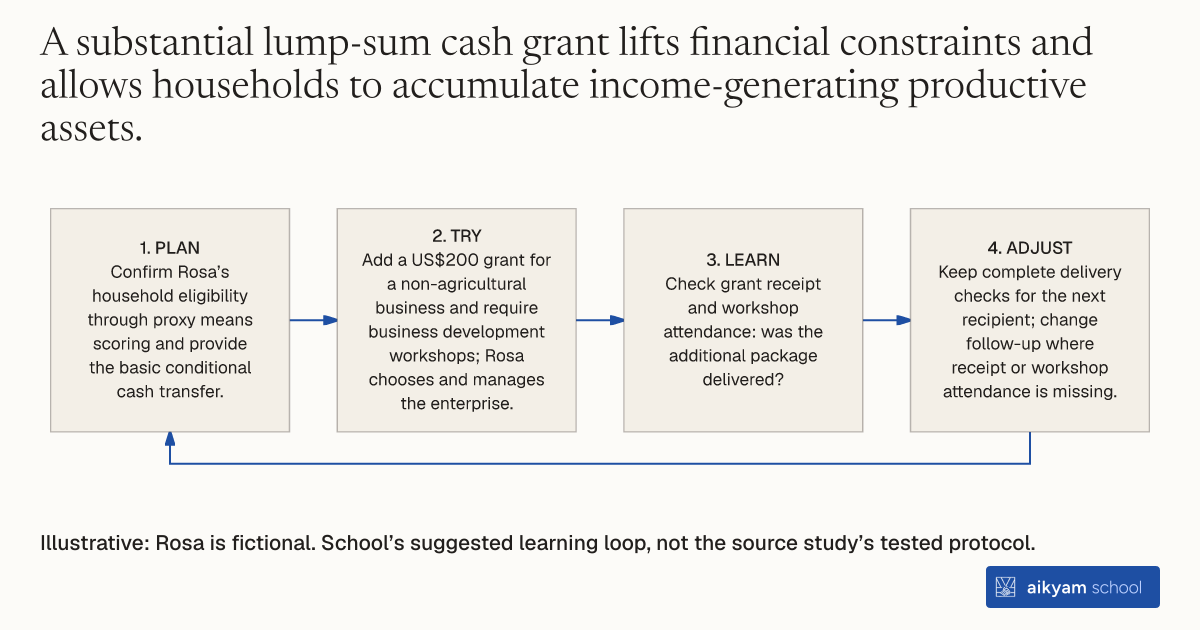
Try, learn and adjust
Check grant and workshop delivery
- Plan: Confirm Rosa’s household eligibility through proxy means scoring and provide the basic conditional cash transfer.
- Try: Add a US$200 grant for a non-agricultural business and require business development workshops; Rosa chooses and manages the enterprise.
- Learn: Check grant receipt and workshop attendance: was the additional package delivered?
- Adjust: Keep complete delivery checks for the next recipient; change follow-up where receipt or workshop attendance is missing.
Illustrative: Rosa is fictional. School’s suggested learning loop, not the source study’s tested protocol.
See source →School’s suggested, untested learning loop. Observe grant receipt, workshops and enterprise choice; no income gain is assumed for Rosa.
How
When to use
Poor rural households often lack financial liquidity and capital to start non-agricultural micro-enterprises. Restricted income sources reduce overall household expenditure capacity and long-term economic resilience. Apply this intervention for poor female caregivers seeking to generate off-farm commercial income.
Provide low-income female caregivers with a lump-sum cash grant to start small non-agricultural micro-enterprises alongside basic conditional cash transfers.
- Identify eligible low-income households in target municipalities using proxy means scoring.
- Deliver the basic conditional cash transfer package to primary female caregivers.
- Award an additional 200 US dollar lump-sum cash grant designated for productive investment in non-agricultural activities.
- Require beneficiaries to attend technical development workshops on small business development.
- Permit beneficiaries full discretion in choosing and managing their non-agricultural commercial enterprise.
Why it works
Increased non-agricultural self-employment generates higher long-term income and consumption levels even after cash transfers end.
Example
In 2006, the Ministry of the Family in Nicaragua awarded a 200 US dollar productive grant to one-third of three thousand eligible rural households across six municipalities, achieving a ninety-nine percent take-up rate among targeted families.
About the study
Participants
1,000 eligible poor households assigned to the productive grant package out of 3,000 total eligible study households across 56 treatment communities in 6 municipalities of northwestern Nicaragua.
Study Design
Two-stage randomized controlled trial assigning communities to treatment or control, followed by public lottery assignment of transfer packages among registered beneficiaries.
Results
Program take-up reached 99 percent, and total household cash transfers ranged up to 34 percent of average annual household income, leading to sustained gains in non-agricultural income two years after transfers ended.