Research steps
Evaluate a synthetic target rule
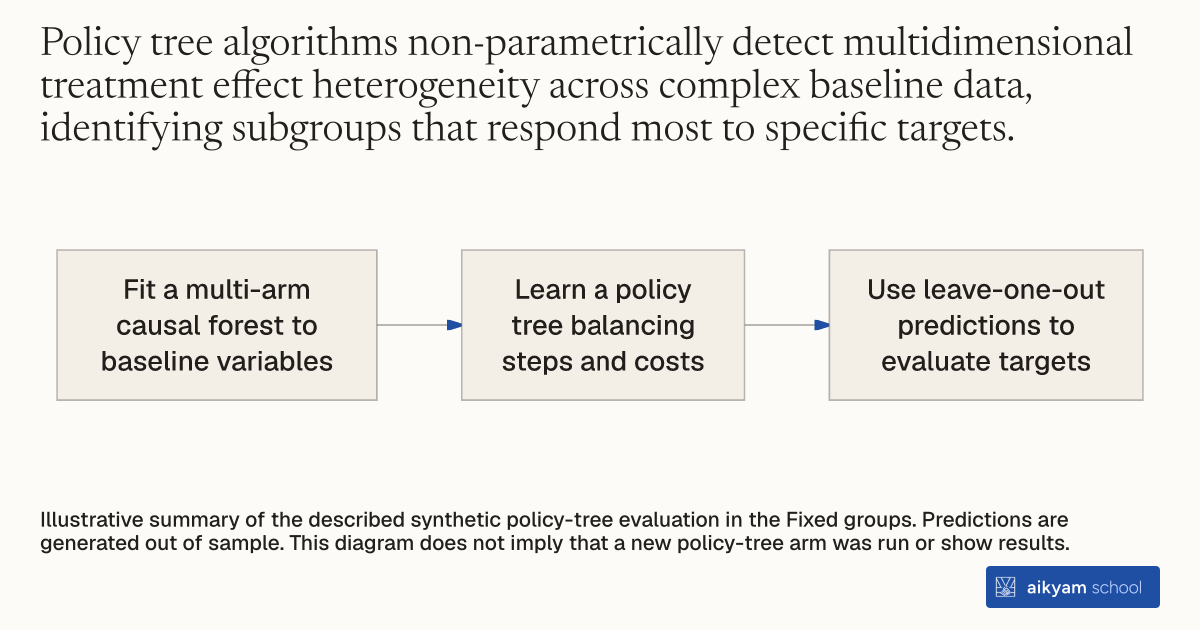
- Fit a multi-arm causal forest to baseline variables
- Learn a policy tree balancing steps and costs
- Use leave-one-out predictions to evaluate targets
Illustrative summary of the described synthetic policy-tree evaluation in the Fixed groups. Predictions are generated out of sample. This diagram does not imply that a new policy-tree arm was run or show results.
See source →How
When to use
Health programs seeking to personalize physical activity contracts often collect extensive baseline data on participant health, demographics, and past exercise. Determining which individual characteristics best predict responsiveness to different contract targets is complex, making simple rules inaccurate. Machine learning policy tree algorithms analyze multi-variable baseline data to assign optimal, personalized step targets.
Personalize incentive contracts by estimating an optimal decision rule across observable baseline characteristics using a multi-arm causal forest and policy tree algorithm.
- Collect a comprehensive set of participant baseline covariates, including health measurements, demographics, wealth indicators, and baseline walking steps.
- Estimate a multi-arm causal forest across experimental benchmark arms to predict individual treatment effect heterogeneity for higher versus lower step targets.
- Apply a doubly-robust policy tree learning algorithm to compute a bounded-depth decision tree that maximizes expected steps net of incentive costs.
- Use a leave-one-out cross-validation procedure to generate out-of-sample optimal target predictions for each individual and prevent overfitting.
- Assign each participant to their policy-tree-recommended step target contract for the program contract period.
Why it works
This data-driven targeting optimizes target assignment when theoretical single-variable rules fail to capture full participant responsiveness.
Example
In Coimbatore, Tamil Nadu, India, researchers trained a policy tree on Fixed group participants using all baseline variables, constructing a synthetic tag that achieved 8,081 daily steps and matched the performance of the incentive-compatible Choice menu.
About the study
Participants
2,784 participants across Fixed groups (778 Fixed Low, 1,210 Fixed Medium, 796 Fixed High) used to train and evaluate synthetic tags within the 6,882 enrolled adult sample in Coimbatore, Tamil Nadu, India.
Study Design
Methodological evaluation comparing synthetic policy tree tagging (using multi-arm causal forest and doubly-robust policy tree learning on All Variables or Policy Variables) against Choice and one-size-fits-all Fixed Medium contracts.
Results
Machine learning tagging on All Variables generated 496 additional daily steps above Fixed Medium at an additional daily payment of 0.84 INR, whereas tagging on non-manipulable Policy Variables (excluding baseline steps and wealth) generated 29 fewer daily steps than Fixed Medium and was significantly outperformed by Choice (p-value 0.015).