Research procedure
Build and test court outcome forecasts
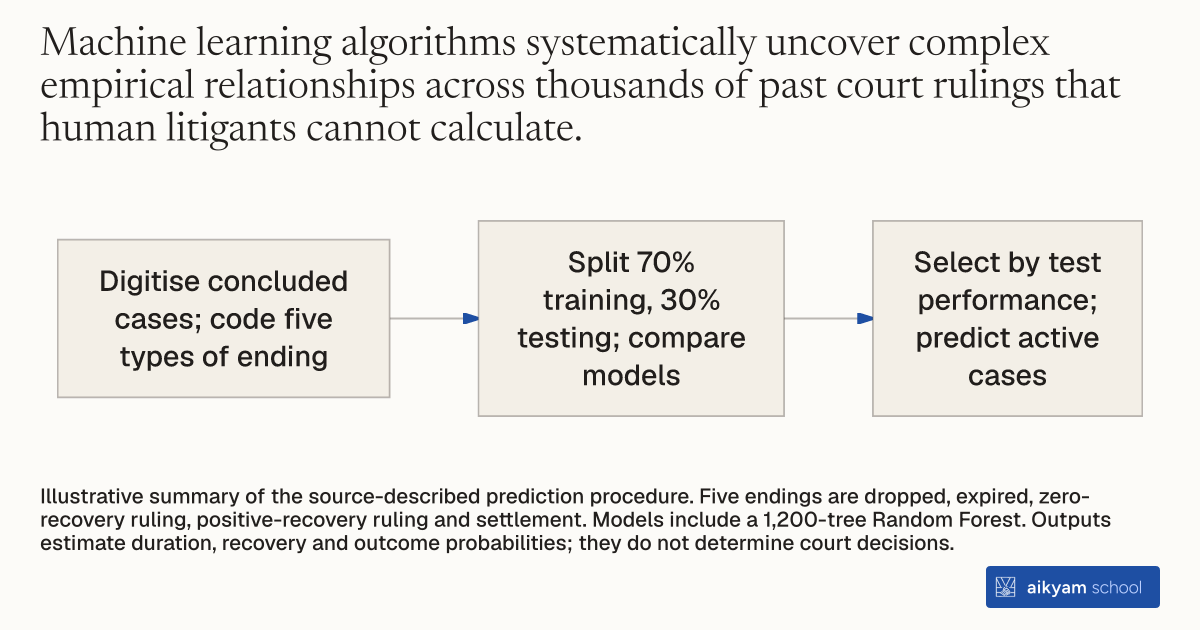
- Digitise concluded cases; code five types of ending
- Split 70% training, 30% testing; compare models
- Select by test performance; predict active cases
Illustrative summary of the source-described prediction procedure. Five endings are dropped, expired, zero-recovery ruling, positive-recovery ruling and settlement. Models include a 1,200-tree Random Forest. Outputs estimate duration, recovery and outcome probabilities; they do not determine court decisions.
See source →How
When to use
Courts in developing countries accumulate massive case backlogs due to asymmetric information, legal misinformation, and low settlement rates among disputing parties. Disputants and legal representatives lack objective benchmarks for lawsuit duration and expected financial recovery. This method trains machine learning algorithms on historical court case files to generate precise, individualised outcome predictions for active legal disputes.
Build predictive statistical models using digitized historical court case files to generate objective predictions of lawsuit outcomes and expected recovery amounts.
- Digitise historical case files from concluded court cases and extract initial filing variables, including wage, tenure, weekly hours, gender, lawyer type, social security status, at-will status, specific claims, and industry.
- Code case termination outcomes, classifying cases into five endings: dropped, expired, judge ruling with zero recovery, judge ruling with positive recovery, or settlement.
- Split the historical dataset into a 70 percent training sample and a 30 percent testing sample for algorithm cross-validation.
- Fit multiple statistical models, including Logistic Regression, Probit, Random Forest, Neural Networks, Gradient Boosting, OLS, and Ridge Regression across all discrete and continuous outcomes.
- Select the model for each outcome that maximises correlation between actual and predicted values on the testing set, using a 1,200-tree Random Forest algorithm for classification and regression tasks.
- Feed initial case variables from new or active lawsuits into the selected models to compute expected monetary recovery, case duration, and probabilities for each outcome ending.
Why it works
Providing these objective statistical predictions replaces subjective overconfidence with reliable empirical benchmarks, encouraging realistic dispute resolution.
Example
In the Mexico City Labor Court, researchers digitised 5,005 concluded case files from 2011 to train predictive algorithms across five subcourts. The resulting machine learning calculator successfully generated individualised settlement benchmarks and outcome probabilities for 1,693 ongoing and pre-suit experimental cases across three field trial phases.
About the study
Participants
5,005 concluded historical case files from 2011 across 5 subcourts of the Mexico City Labor Court used to train and test the predictive models.
Study Design
Model training and validation using a 70-30 train-test split, evaluating Logistic Regression, Probit, Random Forest (1,200 trees), Neural Networks, and Gradient Boosting via cross-validation to select lowest test-set error models.
Results
Selected Random Forest classification models achieved an 86 percent accuracy rate on test set classification, while test-set correlations between predicted and actual values reached 0.61 to 0.93 across discrete outcomes and 0.61 to 0.76 for total compensation.