Research prediction
Predict debate performance beyond attendees
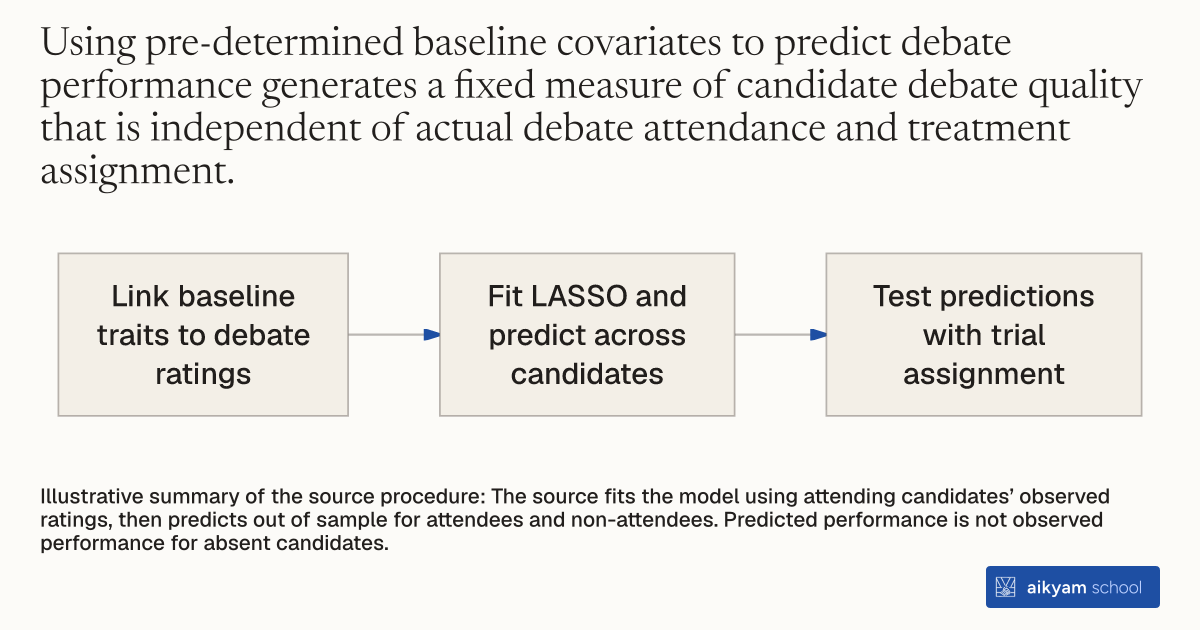
- Link baseline traits to debate ratings
- Fit LASSO and predict across candidates
- Test predictions with trial assignment
Illustrative summary of the source procedure: The source fits the model using attending candidates’ observed ratings, then predicts out of sample for attendees and non-attendees. Predicted performance is not observed performance for absent candidates.
See source →How
When to use
When evaluating the electoral impact of political debates, measuring performance only among actual debaters creates selection bias because candidate attendance is voluntary. Evaluators need an unbiased benchmark of debate quality for every candidate regardless of participation. This method predicts candidate debate performance out-of-sample using baseline candidate characteristics.
Predict candidate debate performance out-of-sample using LASSO regression on baseline candidate characteristics.
- Measure perceived debate performance among candidates who actually attended district debates using post-debate voter surveys.
- Collect pre-determined baseline candidate characteristics, including gender, incumbency status, political party affiliation, baseline citizen assessments of competence, baseline policy priorities, and baseline certainty regarding candidate competence and priorities.
- Fit a flexible LASSO regression model predicting observed debate performance using these baseline candidate covariates.
- Predict out-of-sample debate performance scores for non-participating candidates as well as participating candidates across the full sample.
- Interact predicted debate performance scores with randomized treatment assignment to estimate unconfounded moderated treatment effects on voting behavior.
Why it works
This avoids endogeneity while allowing evaluators to test whether voters reward candidates who are predicted to excel in public debates.
Example
Researchers used a LASSO regression model to predict debate performance for all 984 legislative candidates across Liberia's 73 electoral districts in 2017. Interacting predicted performance with the invitation treatment showed that incumbents with high predicted debate performance gained 8.2 percentage points in polling station vote share in treated districts.
About the study
Participants
984 legislative candidates across 73 electoral districts in Liberia during the October 2017 legislative election.
Study Design
Machine-learning prediction using LASSO regression fitted on observed debate performance of participating candidates using baseline survey covariates, then predicted out-of-sample for all candidates.
Results
Interacting treatment assignment with predicted debate performance revealed that incumbents predicted to perform well experienced a 6.7 percentage point increase in individual vote choice and an 8.2 percentage point increase in polling station vote share.