Research measures
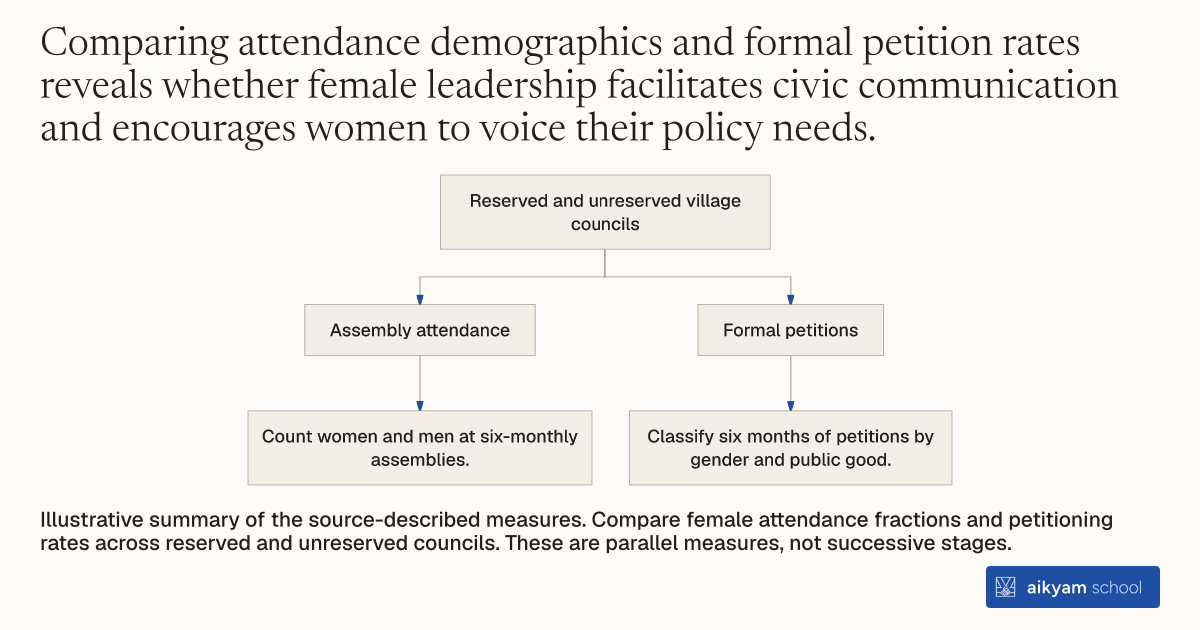
Measure participation through two channels
Reserved and unreserved village councils
- Assembly attendance
- Count women and men at six-monthly assemblies.
- Formal petitions
- Classify six months of petitions by gender and public good.
Illustrative summary of the source-described measures. Compare female attendance fractions and petitioning rates across reserved and unreserved councils. These are parallel measures, not successive stages.
See source →How
When to use
Evaluating whether democratic governance policies increase active civic engagement among marginalized groups is difficult without objective measures. Relying solely on voter turnouts masks ongoing barriers to active policy involvement and public deliberation. Measuring assembly attendance rates and direct petition submissions by gender provides clear empirical metrics of democratic participation.
Track attendance composition at public assemblies and record direct citizen petition submissions to measure group-specific civic participation.
- Survey researchers record the total number of attendees at mandatory biannual village council assemblies.
- Researchers count the number of women and men present at each assembly to calculate the female participation fraction.
- Council presidents maintain formal logbooks recording every complaint and petition brought by citizens over six months.
- Surveyors collect and classify all logged complaints by petitioner gender and public goods request category.
- Evaluators compare female assembly attendance percentages and petitioning rates across reserved and unreserved councils.
Example
In West Bengal, measuring assembly demographics showed that reserved councils increased female assembly attendance from 6.9% to 9.8% and doubled female petitioning rates from 11% to 20%.
About the study
Participants
265 village councils (165 in West Bengal and 100 in Rajasthan) serving rural populations of 10,000 residents each.
Study Design
Comparative evaluation measuring the proportion of women attending biannual general assemblies and submitting formal petitions to council heads across reserved and unreserved councils.
Results
Female council heads in West Bengal increased female assembly attendance from 6.9% to 9.8% and complaint submissions from 11% to 20%, whereas female assembly attendance in Rajasthan was 20.41% in reserved councils and 24.49% in unreserved councils.