Try, learn and adjust
Check the main meeting covers development and secrecy
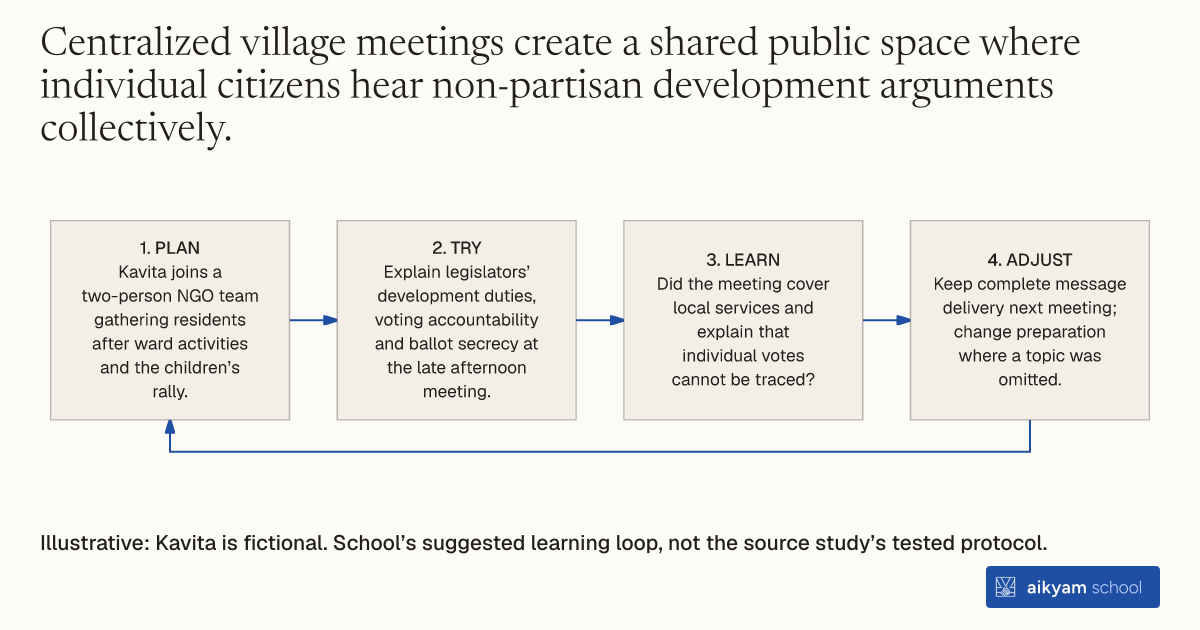
- Plan: Kavita joins a two-person NGO team gathering residents after ward activities and the children’s rally.
- Try: Explain legislators’ development duties, voting accountability and ballot secrecy at the late afternoon meeting.
- Learn: Did the meeting cover local services and explain that individual votes cannot be traced?
- Adjust: Keep complete message delivery next meeting; change preparation where a topic was omitted.
Illustrative: Kavita is fictional. School’s suggested learning loop, not the source study’s tested protocol.
See source →School’s suggested learning loop, not a tested source procedure. Observe message coverage and campaign exposure; the meeting was one component of the evaluated campaign.
How
When to use
In rural elections across developing democracies, local citizens often vote along traditional caste lines rather than holding representatives accountable for local development. Main village-level campaign meetings gather the broader community together to hear a non-partisan core message before evening entertainment events. This brings male and female villagers into a shared forum to discuss how election outcomes affect local infrastructure and public service delivery.
Convene a central village-level assembly in the late afternoon to deliver the campaign's core message linking voting to local development.
- Deploy a two-person NGO campaign team to gather residents at a central village meeting location during the late afternoon.
- Assemble men, women, and local leaders following the conclusion of afternoon ward-level activities and children's rallies.
- Deliver the core non-partisan message emphasizing that legislative representation and responsiveness to local development needs are fundamental job obligations of elected officials.
- Explain how voting functions as a democratic mechanism to hold politicians accountable for local infrastructure like roads, electricity grids, and sanitation.
- Remind attendees that vote choices are secret under push-button electronic voting machines, removing fear of retribution from local power brokers.
Why it works
Emphasizing ballot secrecy alongside the legislator's duty to provide public goods reduces individual fear of retributive politicians and undercuts caste-based voting heuristics.
Example
NGO field teams from Sarathi conducted main village-level meetings across treated villages in 36 polling-station clusters in central Uttar Pradesh during the 2007 state assembly election. The campaign increased reported exposure to NGO activities by 20 percentage points, reduced lower-caste voting for caste-preferred candidates from 57.6% to 47.6%, and increased male voter turnout by 11 percentage points.
About the study
Participants
The trial evaluated 36 polling-station clusters (each containing 12 to 20 villages) across Lalitpur, Bahraich, and Sitapur districts in rural Uttar Pradesh, India, surveying 1,538 Hindu voters.
Study Design
Researchers evaluated the central meeting as part of a randomized cluster field experiment where two-person campaign teams executed a structured one-day campaign schedule, measuring turnout via Election Commission data and voter choices via post-election private ballot surveys.
Results
Survey data showed a 20 percentage point increase in reported NGO campaign exposure in treated villages, an overall 9 percentage point increase in voter turnout (11 percentage points for men), and a 10 percentage point reduction in lower-caste voting for caste-preferred parties.