Research overview
Test donation examples
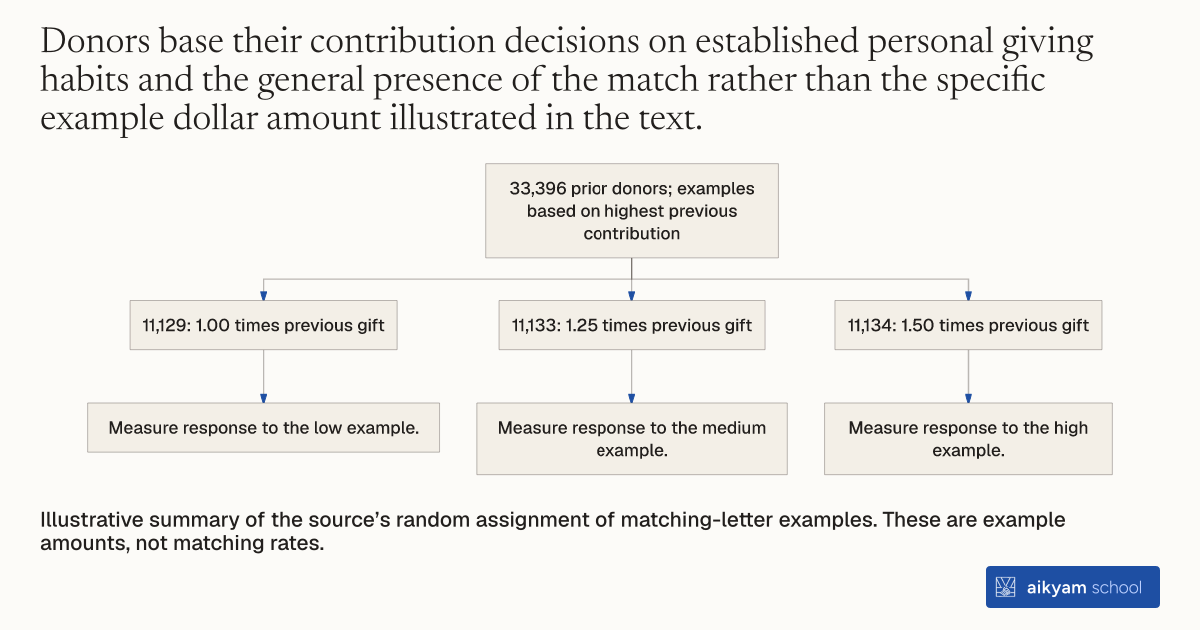
33,396 prior donors; examples based on highest previous contribution
- 11,129: 1.00 times previous gift
- Measure response to the low example.
- 11,133: 1.25 times previous gift
- Measure response to the medium example.
- 11,134: 1.50 times previous gift
- Measure response to the high example.
Illustrative summary of the source’s random assignment of matching-letter examples. These are example amounts, not matching rates.
See source →How
When to use
Fundraisers often include suggested contribution amounts in matching grant letters to guide donor behavior. Higher example amounts might encourage larger donations, but could also discourage participation if perceived as too high. Testing different example amounts based on donor history helps charities determine whether suggested figures alter total revenue.
Set example donation amounts in matching grant solicitation letters relative to each recipient's highest previous contribution.
- Retrieve prior contribution records for all direct mail solicitation recipients.
- Calculate three suggested ask amounts for each recipient on their reply card: equal to their highest previous contribution (1.00x HPC), 1.25 times HPC, and 1.50 times HPC.
- Divide the matching grant recipient pool into three equal random treatment sub-groups.
- Assign the low example treatment sub-group an example donation figure equal to 1.00 times their highest previous contribution in the matching grant text.
- Assign the medium example treatment sub-group an example donation figure equal to 1.25 times their highest previous contribution in the matching grant text.
- Assign the high example treatment sub-group an example donation figure equal to 1.50 times their highest previous contribution in the matching grant text.
- Print the assigned example amount in the matching grant paragraph on page two of the solicitation letter and measure donor response.
Example
A civil liberties nonprofit in the United States mailed solicitations testing low (1.00x HPC), medium (1.25x HPC), and high (1.50x HPC) example amounts to 33,396 prior donors split into three equal sub-groups of 11,129, 11,133, and 11,134. The low, medium, and high example amounts produced similar response rates (2.2 percent, 2.3 percent, and 2.1 percent) and revenue per letter (\$0.98, \$1.00, and \$0.91).
About the study
Participants
33,396 prior donors to a US civil liberties nonprofit, randomly assigned into three groups of 11,129 (low), 11,133 (medium), and 11,134 (high).
Study Design
Randomized natural field experiment testing low, medium, and high example donation figures in matching text within direct mail letters sent in August 2005.
Results
Probit regressions showed no statistically significant effect for medium or high example amounts on donation probability relative to the low example baseline (0.001 marginal effect, standard error 0.002, p > 0.10).