Research measurement
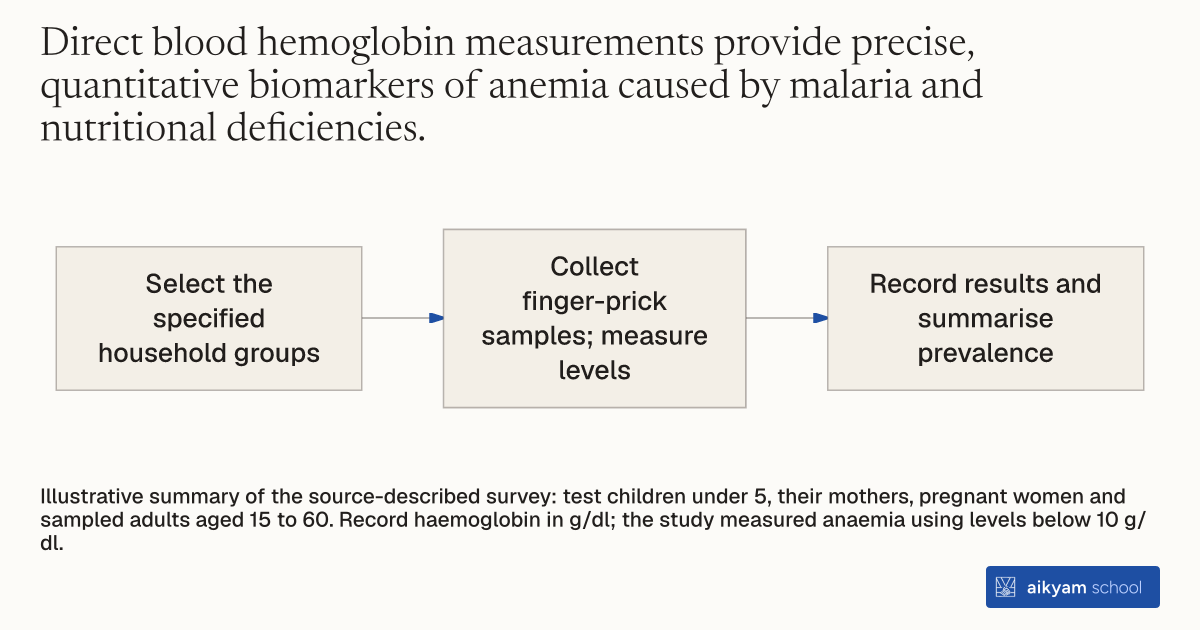
Measure haemoglobin in sampled household members
- Select the specified household groups
- Collect finger-prick samples; measure levels
- Record results and summarise prevalence
Illustrative summary of the source-described survey: test children under 5, their mothers, pregnant women and sampled adults aged 15 to 60. Record haemoglobin in g/dl; the study measured anaemia using levels below 10 g/dl.
See source →How
When to use
Health programs in malaria-endemic areas need objective indicators to measure chronic health impacts like anemia. Malaria infections cause red blood cell destruction, but self-reported symptoms cannot quantify the resulting blood loss. Measuring hemoglobin levels provides field teams with objective biomarkers of chronic morbidity across vulnerable demographics.
Screen high-risk household members for anemia by measuring individual hemoglobin levels during household survey visits.
- Target vulnerable household groups including children under five, their mothers, pregnant women, and a random sample of adults aged 15 to 60.
- Prick the finger of each selected participant to draw a small blood sample during the household survey visit.
- Test the blood sample in the field using portable diagnostic equipment to measure exact hemoglobin concentrations in grams per deciliter.
- Record hemoglobin concentrations and identify individuals falling below the clinical anemia threshold of 10 g/dl.
- Aggregate individual hemoglobin readings across tested demographic groups to evaluate population-level anemia prevalence.
Why it works
This objective data avoids subjective reporting biases and captures chronic health burdens across vulnerable community members.
Example
Survey teams measured hemoglobin levels in 2,683 individuals across 1,947 households in rural Orissa, India, in May–June 2007. The biomarker tests identified moderate anemia with hemoglobin under 10 g/dl in 23 percent of tested males and 35 percent of tested females.
About the study
Participants
2,683 individuals (965 males and 1,718 females) tested across 1,947 households in 150 villages in Bargarh, Balangir, Kandhamal, Keonjhar, and Sambalpur districts in Orissa, India, where over 90 percent of households belong to Scheduled Castes, Scheduled Tribes, or Other Backward Castes.
Study Design
Survey monitors collected finger-prick blood samples from children under five, their mothers, pregnant women, and a random sample of working-age adults during a baseline household survey to test hemoglobin levels and screen for anemia below 10 g/dl.
Results
Anemia prevalence with hemoglobin levels below 10 g/dl was 23 percent among tested males across 965 observations and 35 percent among tested females across 1,718 observations.