Research procedure
Contain promotion during the trial
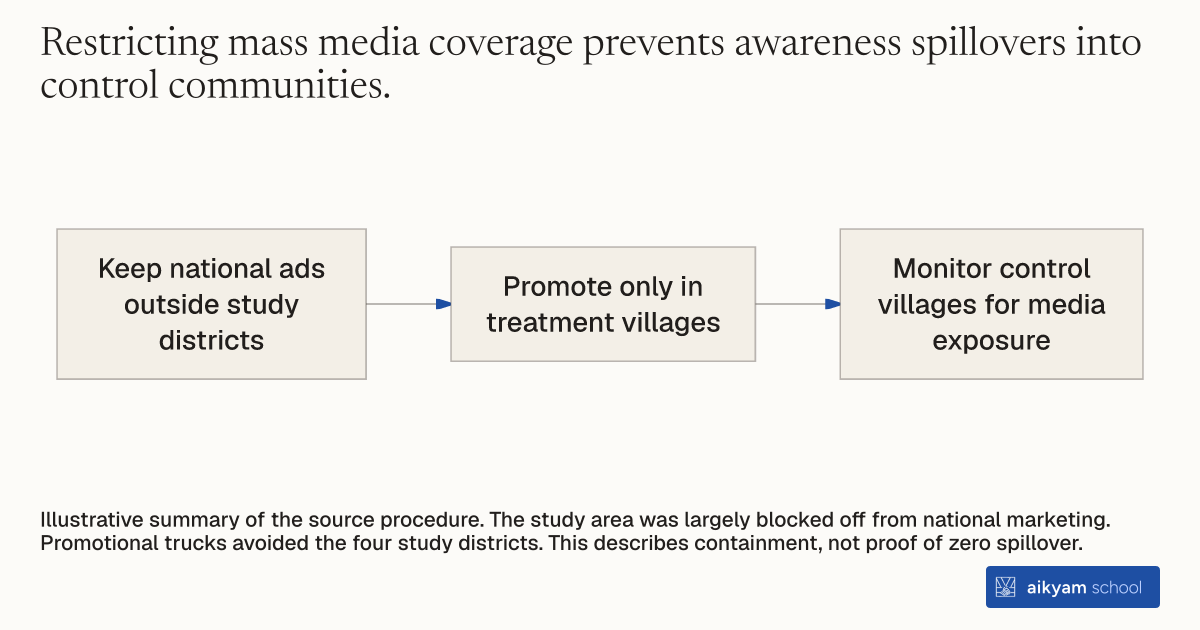
- Keep national ads outside study districts
- Promote only in treatment villages
- Monitor control villages for media exposure
Illustrative summary of the source procedure. The study area was largely blocked off from national marketing. Promotional trucks avoided the four study districts. This describes containment, not proof of zero spillover.
See source →How
When to use
Evaluating public services in field experiments risks contamination if national mass media marketing reaches control areas. Uncontrolled broadcasting of promotional campaigns causes spillover, reducing adoption differences between treatment and control groups. This method isolates study districts from national radio and print advertising during field trials.
Isolate field study districts from national marketing and broadcast campaigns to prevent control group contamination.
- Evaluators coordinate with program marketing directors to restrict national mass media advertising during evaluation periods.
- Media teams limit radio broadcasts and newspaper advertisements to local media outlets serving non-study regions.
- Mobile operator promotional trucks avoid entering or driving through the four evaluation study districts.
- Marketing firms execute high-intensity localized promotion strictly inside designated treatment village trading centers.
- Survey enumerators monitor control villages to confirm that mass media campaigns do not reach control respondents.
Why it works
Concentrating promotion strictly within assigned treatment sites maintains a clear uptake differential for rigorous evaluation.
Example
Evaluators blocked off four study districts in central Uganda from national radio and print ads, ensuring 6001 service awareness remained at 24% in control villages compared to 48% in treatment villages.
About the study
Participants
2,424 adults aged 18 to 35 with at least six years of primary education in 60 villages across Masaka, Mpigi, Mityana, and Mubende districts in central Uganda.
Study Design
Clustered RCT where national media marketing was geographically contained outside four study districts to prevent control village contamination.
Results
Geographic containment limited control village awareness to 24% and service usage to 7%, compared to 48% awareness and 40% usage in treatment villages (p = 0.00).