Try, learn and adjust
Check the extension information chain
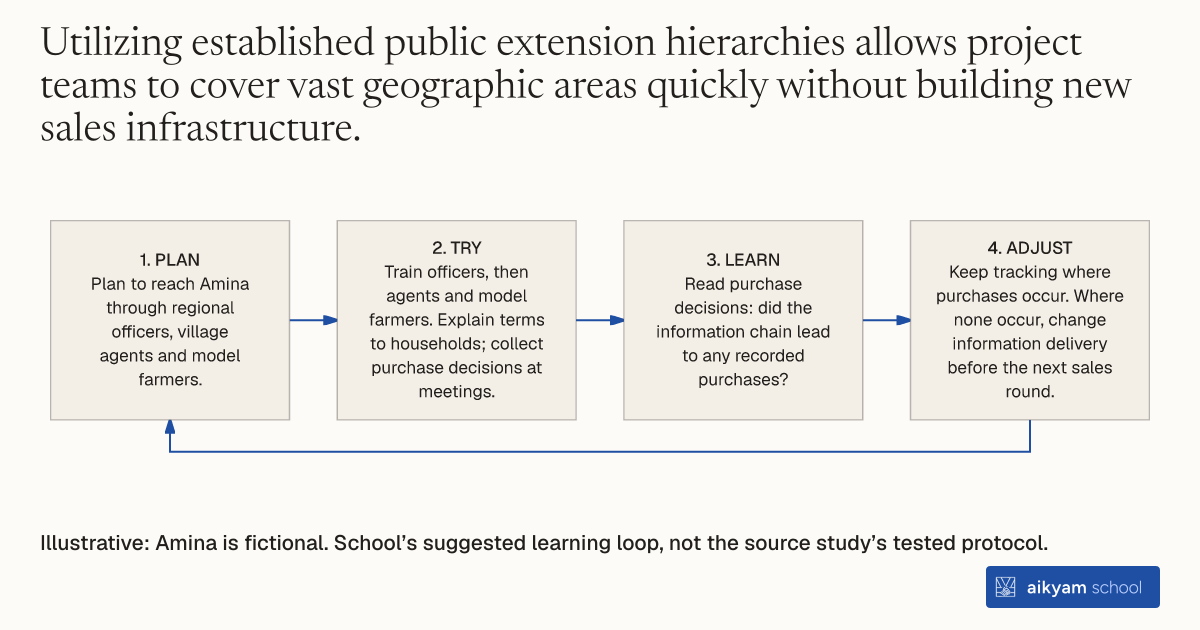
- Plan: Plan to reach Amina through regional officers, village agents and model farmers.
- Try: Train officers, then agents and model farmers. Explain terms to households; collect purchase decisions at meetings.
- Learn: Read purchase decisions: did the information chain lead to any recorded purchases?
- Adjust: Keep tracking where purchases occur. Where none occur, change information delivery before the next sales round.
Illustrative: Amina is fictional. School’s suggested learning loop, not the source study’s tested protocol.
See source →School’s suggested learning loop: observe recorded purchase decisions. Indirect communication contributed to zero uptake in 11 of 34 cooperatives; this loop is a delivery aid.
How
When to use
Smallholder farmers in remote rural communities often lack direct contact with financial institutions offering complex new agricultural products. Insurance providers and research teams face high costs when attempting to visit scattered households individually. Disseminate product information through local government extension workers and community model farmers to reach rural households.
Deliver complex product information to rural smallholders by cascading training materials through regional extension networks and model farmers.
- Project managers train regional Ministry of Agriculture officers on contract features and rules.
- Regional officers instruct local village extension agents on product mechanics and participation steps.
- Village extension agents brief community model farmers during local agricultural meetings.
- Model farmers explain policy terms and application steps to neighboring smallholder households.
- Village extension agents collect product purchase decisions from interested farmers during community meetings.
Why it works
Village extension workers and model farmers hold existing community trust that opens initial dialogue with smallholders.
Example
In Amhara, Ethiopia, researchers used Ministry of Agriculture officials, village extension agents, and model farmers to explain weather index insurance across 34 treatment cooperatives. Indirect communication across this multi-layered network contributed to sales failing completely in 11 out of 34 cooperatives.
About the study
Participants
34 treatment primary cooperative villages across 4 zones in Amhara, Ethiopia.
Study Design
Observational field implementation audit analyzing information delivery channels and insurance sales outcomes across primary cooperatives.
Results
Indirect information delivery through extension intermediaries contributed to zero insurance uptake in 11 out of 34 treatment primary cooperatives (32.4%).