Research measurement
Check mobility against survey reports
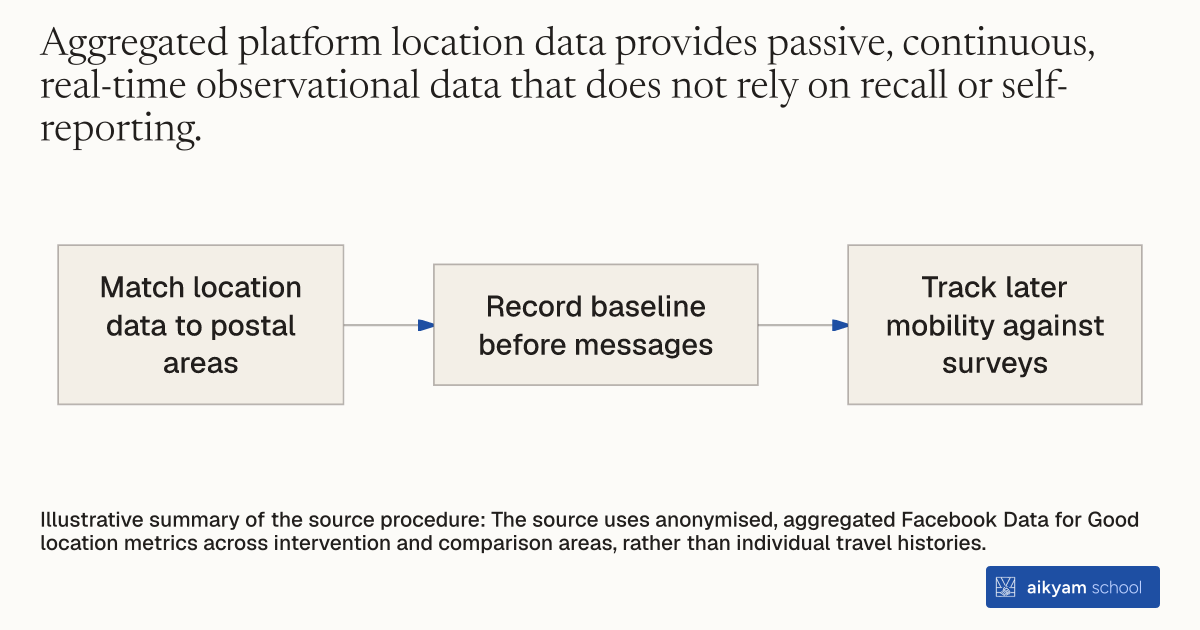
- Match location data to postal areas
- Record baseline before messages
- Track later mobility against surveys
Illustrative summary of the source procedure: The source uses anonymised, aggregated Facebook Data for Good location metrics across intervention and comparison areas, rather than individual travel histories.
See source →How
When to use
During public health emergencies or lockdowns, authorities and researchers need passive, objective ways to measure population-level mobility changes. Self-reported travel survey data can be subject to recall or social desirability bias. Researchers can track aggregated mobility trends across geographic units using platform location data to evaluate whether stay-at-home recommendations are working.
Track population mobility using aggregated platform location data to validate self-reported travel reductions during public health campaigns.
- Research teams set up geographic boundary units matching postal index areas across target regions.
- Researchers connect to Facebook's 'Data for Good' platform to access anonymized, aggregated location tracking metrics.
- Researchers collect baseline mobility metrics for phone users across intervention and control postal index areas.
- Public health messages encouraging individuals to stay home are delivered across designated geographic areas.
- Researchers monitor aggregated location signals across postal index areas to corroborate self-reported reductions in travel outside home villages.
Why it works
This objective data stream allows researchers to cross-validate survey findings across large geographical populations without contacting individual citizens.
Example
In West Bengal, India, researchers used Facebook's 'Data for Good' platform location tracking to corroborate whether citizens stayed home after receiving celebrity video messages. The location tracking data confirmed that citizens in treatment postal index areas remained at home, supporting survey findings that travel outside villages dropped by 7.4 percentage points.
About the study
Participants
Mobile phone users across 1,264 postal index areas serving 28 million phone network subscribers in West Bengal, India.
Study Design
A randomized evaluation using aggregated location tracking data from Facebook's 'Data for Good' platform to cross-validate self-reported travel behavior across intervention and comparison areas.
Results
Facebook location tracking corroborated survey findings that celebrity video message recipients were 7.4 percentage points (20 percent) less likely to travel outside their village, indicating increased time spent at home.