Try, learn and adjust
Check step monitoring without rewards
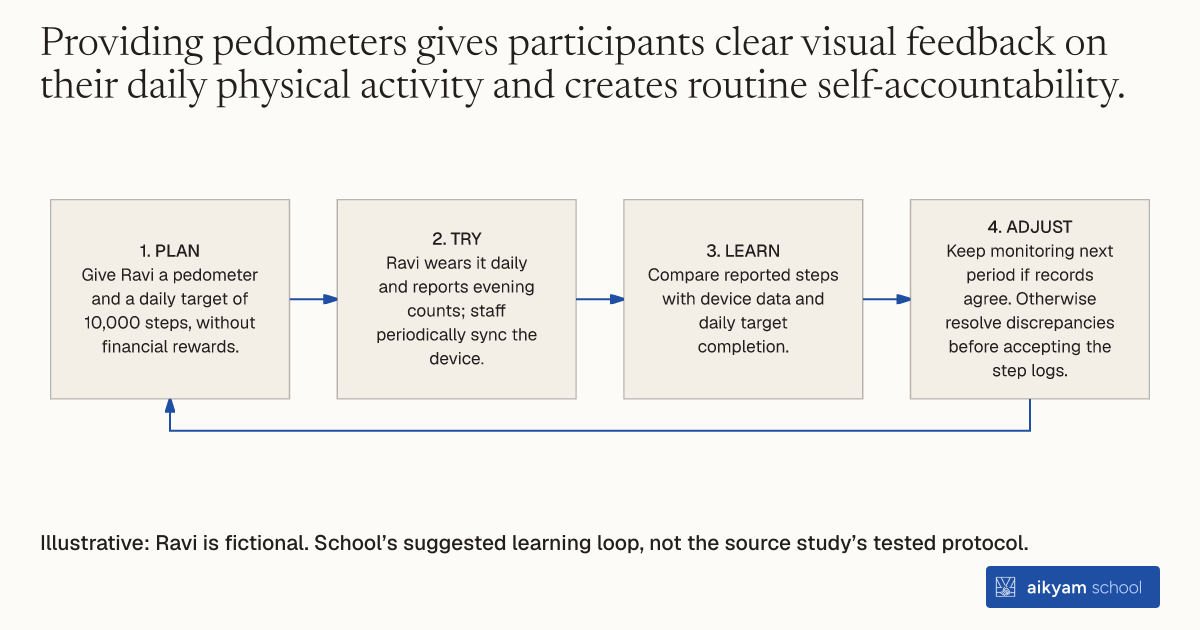
- Plan: Give Ravi a pedometer and a daily target of 10,000 steps, without financial rewards.
- Try: Ravi wears it daily and reports evening counts; staff periodically sync the device.
- Learn: Compare reported steps with device data and daily target completion.
- Adjust: Keep monitoring next period if records agree. Otherwise resolve discrepancies before accepting the step logs.
Illustrative: Ravi is fictional. School’s suggested learning loop, not the source study’s tested protocol.
See source →School’s suggested, untested learning loop. Observe step counts and target completion without rewards; this process check does not establish health benefits.
How
When to use
Diabetic and prediabetic adults need regular physical exercise to manage their blood sugar, but often lack objective feedback on their daily activity. Health programs need a non-monetary baseline strategy to track participant step counts and encourage self-monitoring. Distributing pedometers without financial rewards establishes a baseline level of exercise driven purely by visual tracking and daily reporting.
Issue pedometers and self-reporting instructions to participants to encourage non-incentivized daily step monitoring.
- Distribute pedometers to program participants to wear throughout the day.
- Instruct participants to target 10,000 steps of daily walking activity.
- Require participants to record and report their step counts every evening using an automated phone calling system.
- Conduct periodic field visits to sync pedometer hardware and verify logged step data.
Why it works
Daily evening reporting keeps walking goals prominent without introducing financial reward distortions.
Example
In Coimbatore, India, diabetic and prediabetic participants in a monitoring group received pedometers and reported daily step counts without financial incentives, achieving a 29 percent daily step target compliance rate over twelve weeks.
About the study
Participants
3,192 adults in Coimbatore, India, averaging 49 years old, where 67 percent had doctor-diagnosed diabetes, 82 percent had elevated HbA1c, 49 percent had hypertension, and 61 percent had obesity.
Study Design
A randomized controlled trial evaluating physical activity incentives and step-monitoring contracts among recruited adults across eight intervention and comparison groups over twelve weeks.
Results
Participants receiving pedometers and monitoring without incentives achieved a 29 percent daily target compliance rate, whereas adding financial incentives increased compliance by 20 percentage points to 49 percent.