Research steps
Recruit adults for monitoring
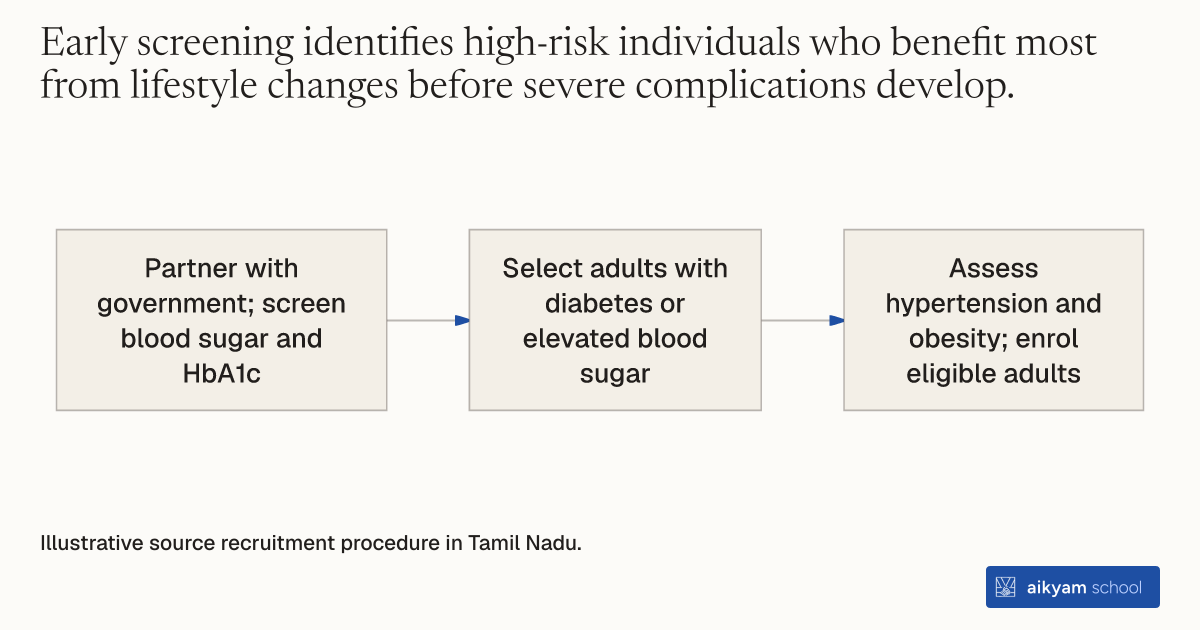
- Partner with government; screen blood sugar and HbA1c
- Select adults with diabetes or elevated blood sugar
- Assess hypertension and obesity; enrol eligible adults
Illustrative source recruitment procedure in Tamil Nadu.
See source →How
When to use
Urban health programmes face rising rates of chronic lifestyle diseases like diabetes. Screening identifies individuals with diagnosed diabetes or high blood sugar who need targeted support. This process targets urban adults living with or at risk for non-communicable diseases.
Identify and recruit urban adults with diabetes or elevated blood sugar through government partnerships.
- Partner with local government health authorities to access target urban populations.
- Screen adults using blood test indicators including HbA1c levels.
- Select individuals diagnosed with diabetes or showing elevated blood sugar levels.
- Assess comorbid health conditions including hypertension and obesity.
- Enroll eligible participants into the lifestyle monitoring program.
Why it works
Partnering with public health authorities allows health programs to reach vulnerable urban populations effectively.
Example
Researchers partnered with the Government of Tamil Nadu in India to identify nearly 3,200 diabetics and pre-diabetics. Participants had an average age of almost 50 years, with 58 percent male, 65 percent doctor-diagnosed diabetes, 81 percent elevated HbA1c levels, 49 percent hypertension, and 61 percent obesity.
About the study
Participants
3,192 diabetics and pre-diabetics in India; average age almost 50 years old; 58 percent male.
Study Design
Randomized controlled trial in partnership with the Government of Tamil Nadu.
Results
Screened cohort showed 65 percent doctor-diagnosed diabetes, 81 percent elevated HbA1c levels, 49 percent hypertension, and 61 percent obesity.