Try, learn and adjust
Use monthly reports to guide usage support
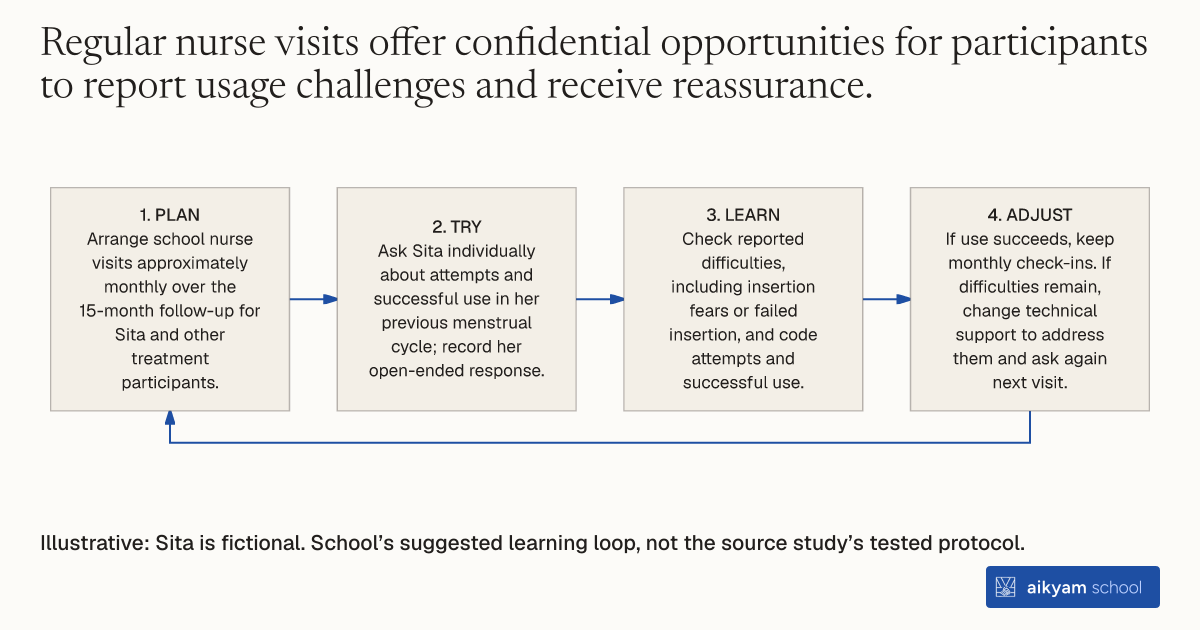
- Plan: Arrange school nurse visits approximately monthly over the 15-month follow-up for Sita and other treatment participants.
- Try: Ask Sita individually about attempts and successful use in her previous menstrual cycle; record her open-ended response.
- Learn: Check reported difficulties, including insertion fears or failed insertion, and code attempts and successful use.
- Adjust: If use succeeds, keep monthly check-ins. If difficulties remain, change technical support to address them and ask again next visit.
Illustrative: Sita is fictional. School’s suggested learning loop, not the source study’s tested protocol.
See source →Observe reported attempts, successful use and difficulties. Check-ins are not evidence that support alone caused adoption. School’s suggested learning loop; not a tested source procedure.
How
When to use
Organisations deploy new personal health tools among adolescent populations over an extended period. Self-reported adoption data and ongoing technical support can be difficult to gather consistently without routine contact points. Monthly school visits by healthcare staff provide structured check-ins for tracking usage and addressing user difficulties.
Conduct monthly in-person check-ins with technology recipients at their schools to monitor adoption and resolve usage barriers.
- Schedule a study nurse to visit participating schools approximately once per month across a 15-month follow-up period.
- Convene treatment group participants individually in school settings during the visit.
- Ask open-ended questions about whether the participant attempted or successfully used the device during her previous menstrual cycle.
- Record open-ended responses regarding difficulties, such as insertion fears or failure to insert, or positive usage experiences.
- Code responses systematically into attempt and successful usage indicators.
- Provide ongoing technical support and encouragement to resolve physical insertion or handling challenges reported by participants.
Why it works
Open-ended questioning elicits candid responses about personal barriers without forcing rigid options.
Example
A study nurse conducted monthly school visits over 15 months in Chitwan, Nepal, tracking 101 treatment girls, observing an average 81 percent contact rate per visit and documenting cup adoption growth from 10 percent in January 2007 to 60 percent by June 2007.
About the study
Participants
101 treatment adolescent female students across four schools in Chitwan District, Nepal observed over 15 months.
Study Design
Monthly in-school visits by a project nurse collecting qualitative open-ended reports on cup attempts and successful usage.
Results
Nurse check-ins achieved an average 81 percent attendance rate per visit, tracking usage growth from 10 percent to 60 percent over six months with no systematic attrition.