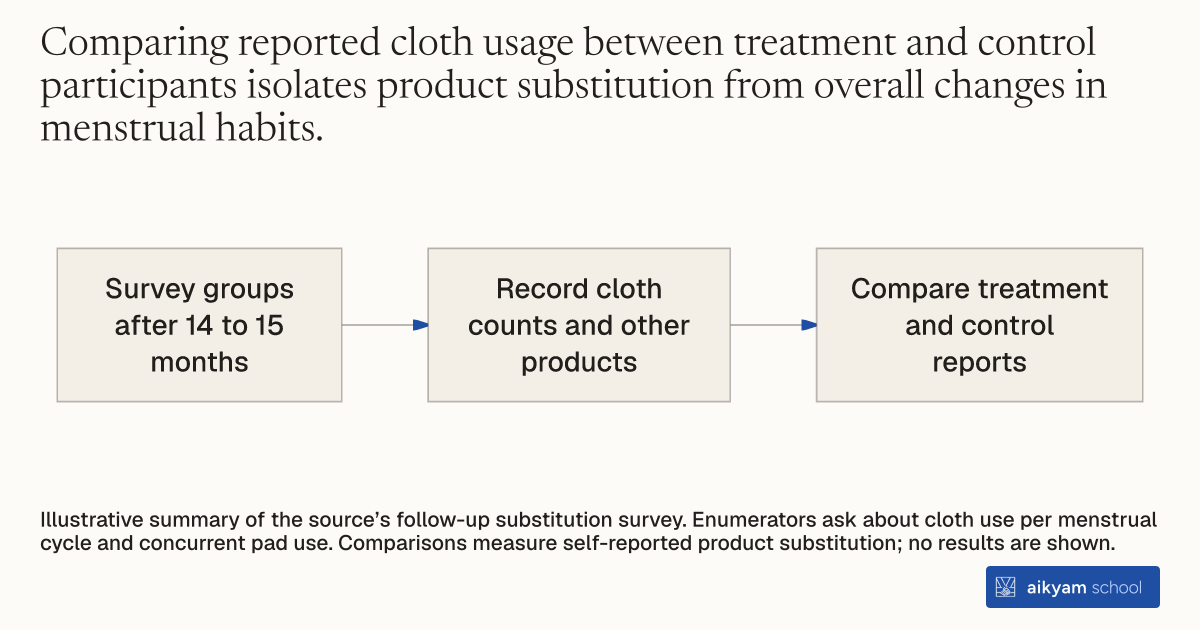
Research procedure
Compare reported menstrual product use
- Survey groups after 14 to 15 months
- Record cloth counts and other products
- Compare treatment and control reports
Illustrative summary of the source’s follow-up substitution survey. Enumerators ask about cloth use per menstrual cycle and concurrent pad use. Comparisons measure self-reported product substitution; no results are shown.
See source →How
When to use
Organisations need to evaluate whether distributing a new personal hygiene technology actually reduces reliance on traditional alternatives. Direct physical observation of sanitary product usage is impossible due to personal privacy. A comparative follow-up survey measures reported shifts in cloth usage and quantities between treatment and control groups over time.
Administer comparative follow-up survey questionnaires to evaluate product substitution by measuring changes in traditional sanitary product usage across groups.
- Convene treatment and control participants at a central meeting approximately 14 to 15 months after baseline product distribution.
- Interview participants using enumerators to complete a standardized follow-up survey instrument.
- Question participants on their ongoing use of traditional menstrual cloths during their regular periods.
- Record the specific number of cloths used per menstrual cycle by each participant.
- Survey participants regarding their concurrent use of commercial sanitary pads or other menstrual products.
- Calculate the percentage point reduction in cloth usage probability and average cloth reduction count between treatment and control groups.
Why it works
Quantitative cloth counts provide concrete evidence of displacement without requiring direct personal observation.
Example
At a 15-month follow-up meeting in Chitwan, Nepal, enumerators surveyed treatment and control adolescent girls, finding treatment girls were 35 percentage points less likely to use traditional cloths and used 1.09 fewer cloths per period.
About the study
Participants
198 adolescent girls (92 percent attending the follow-up meeting across four schools in Chitwan, Nepal).
Study Design
15-month follow-up survey interviewing treatment and control girls on their use and quantity of menstrual cloths and sanitary pads.
Results
Treatment girls were 35 percentage points less likely to use any cloths than control girls and used 1.09 fewer cloths per period, with no significant differences in pad usage.