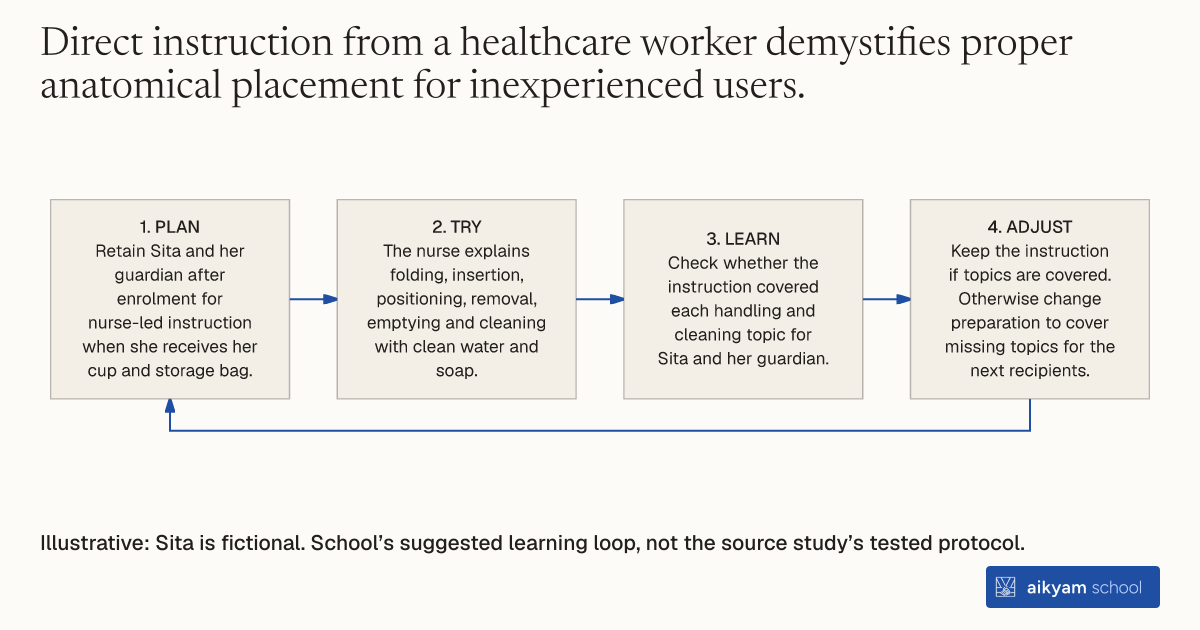
Try, learn and adjust
Check instruction covers handling and cleaning
- Plan: Retain Sita and her guardian after enrolment for nurse-led instruction when she receives her cup and storage bag.
- Try: The nurse explains folding, insertion, positioning, removal, emptying and cleaning with clean water and soap.
- Learn: Check whether the instruction covered each handling and cleaning topic for Sita and her guardian.
- Adjust: Keep the instruction if topics are covered. Otherwise change preparation to cover missing topics for the next recipients.
Illustrative: Sita is fictional. School’s suggested learning loop, not the source study’s tested protocol.
See source →Observe instruction coverage at distribution. This is a learning aid, not a clinical protocol or a safety guarantee. School’s suggested learning loop; not a tested source procedure.
How
When to use
Organisations introduce unfamiliar internal health products to young first-time users. Novel personal hygiene devices require specialized physical orientation before adoption can occur. Trained healthcare professionals deliver standardized instructions immediately following product distribution.
Deliver direct healthcare professional training on folding, insertion, removal, and cleaning when distributing a novel device.
- Retain selected product recipients and their guardians after an enrollment session ends.
- Hand out individual silicone menstrual cups stored in dedicated cloth storage bags.
- Demonstrate how to flatten and fold the silicone bell in half for insertion.
- Explain proper positioning inside the vagina to collect blood and prevent leakage.
- Instruct participants to empty the cup approximately every twelve hours during menstruation.
- Teach users to wash the cup using clean water and soap between uses.
- Warn participants about potential hymen rupture while noting no risk of toxic shock syndrome.
Why it works
Clear cleaning and handling guidelines reduce user safety fears regarding unfamiliar internal health devices.
Example
A study nurse trained 100 adolescent female students and their guardians in Chitwan, Nepal immediately after a lottery. Initial adoption reached 10 percent in month one and grew to 60 percent by month six.
About the study
Participants
100 adolescent female students (aged 14 on average) in treatment group across four schools in Chitwan, Nepal.
Study Design
Randomized field trial offering immediate nurse-led group instruction to lottery winners following baseline enrollment.
Results
Successful cup usage increased from 10% in January 2007 to 60% in June 2007, with 91% continued monthly usage after initial success.