Research procedure
Compare daily laundry time
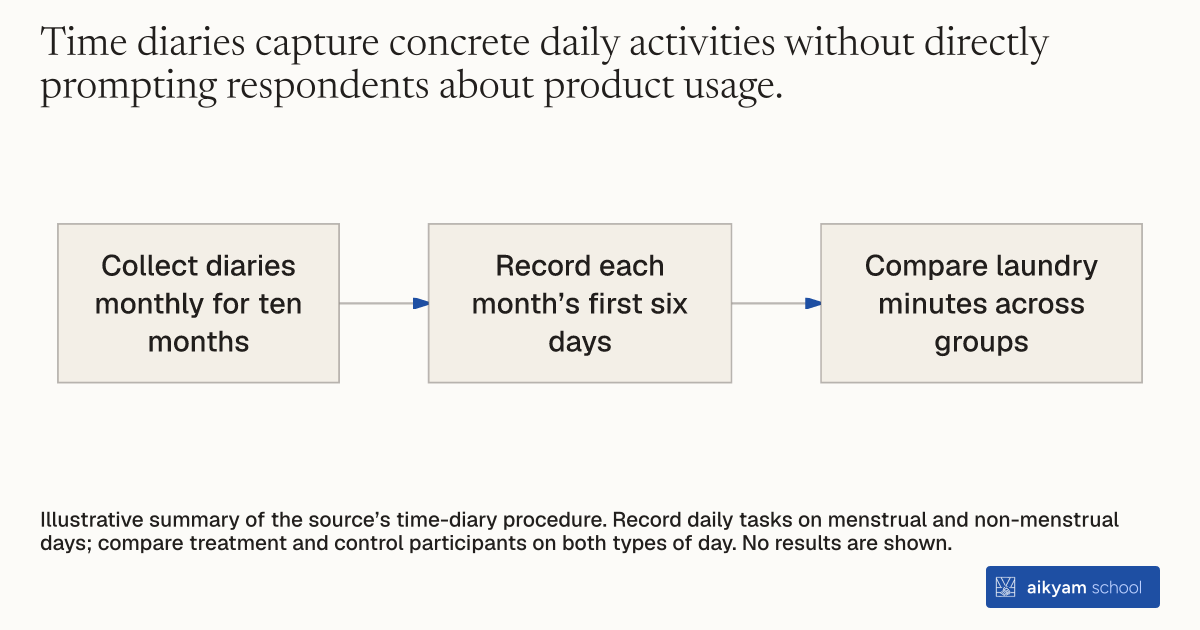
- Collect diaries monthly for ten months
- Record each month’s first six days
- Compare laundry minutes across groups
Illustrative summary of the source’s time-diary procedure. Record daily tasks on menstrual and non-menstrual days; compare treatment and control participants on both types of day. No results are shown.
See source →How
When to use
Organisations need objective behavioural verification when evaluating personal health technologies. Self-reported adoption estimates can suffer from social desirability bias or misreporting among adolescent participants. Monthly multi-day time diaries track daily time allocation changes to verify self-reported product usage.
Collect daily time allocation records over consecutive days each month to measure behavioural changes during menstruation.
- Administer time-diary survey instruments monthly to enrolled participants for the first ten months of a study.
- Direct respondents to record their specific daily activities for the first six days of each calendar month.
- Log daily minutes spent on domestic tasks, including laundering cloths, separately for menstrual and non-menstrual days.
- Calculate individual baseline time spent washing menstrual cloths during period days.
- Compare daily laundry duration between treatment and control participants on menstruation days versus non-menstruation days.
Why it works
Comparing task durations between period and non-period days provides unbiased internal consistency checks for reported adoption.
Example
Researchers administered six-day monthly time diaries for ten months to 198 adolescent girls in Chitwan, Nepal, observing that control girls spent 22 extra minutes on laundry on period days while treatment girls spent only 2 extra minutes.
About the study
Participants
198 adolescent female students (aged 14 on average) across four schools in Chitwan District, Nepal.
Study Design
Monthly time-diary collection recording daily activities across the first six days of each month for the first ten project months.
Results
Control girls spent 22 additional minutes per day on laundry during menstruation, while treatment girls spent only 2 additional minutes, demonstrating high product substitution and confirming self-reported usage.