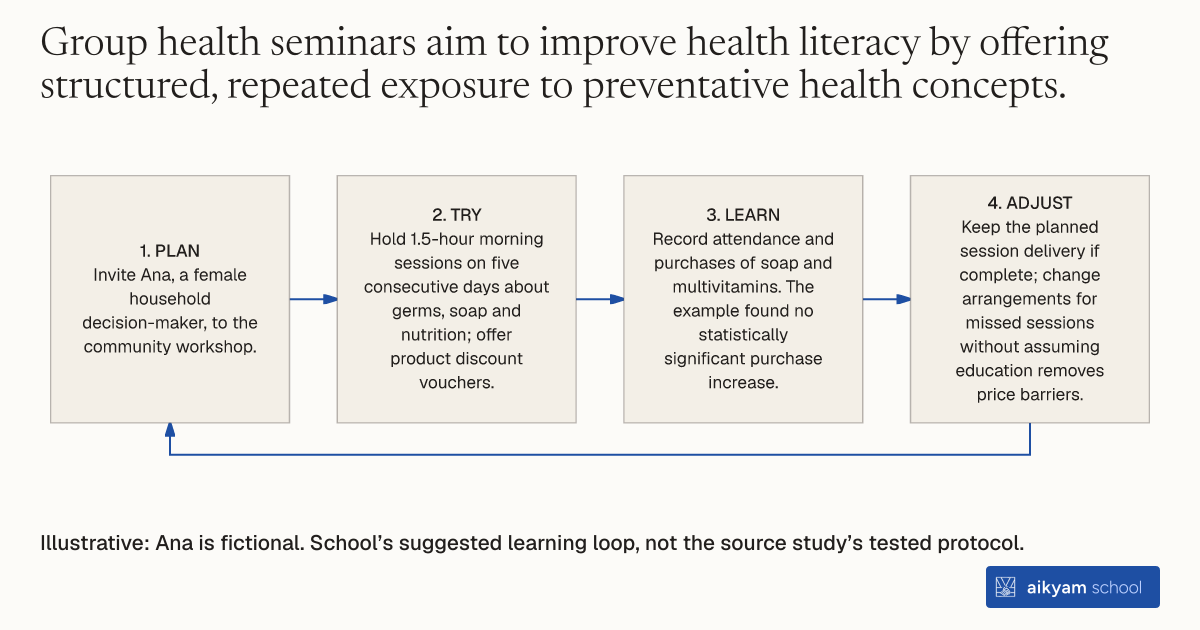
Try, learn and adjust
Check delivery of the five-day health seminar
- Plan: Invite Ana, a female household decision-maker, to the community workshop.
- Try: Hold 1.5-hour morning sessions on five consecutive days about germs, soap and nutrition; offer product discount vouchers.
- Learn: Record attendance and purchases of soap and multivitamins. The example found no statistically significant purchase increase.
- Adjust: Keep the planned session delivery if complete; change arrangements for missed sessions without assuming education removes price barriers.
Illustrative: Ana is fictional. School’s suggested learning loop, not the source study’s tested protocol.
See source →Observe attendance, voucher prices and purchases; do not promise increased product use. School suggests this learning loop; it was not tested by the source.
How
When to use
Low-income households in developing nations often underutilize essential preventative health products like hand soap and multivitamins. Use this method when planning community-level public health education programs to build awareness around hygiene and nutrition. It applies to organizations attempting to boost preventative health adoption through structured group education sessions.
Organize structured, multi-day public health education seminars in target communities to teach residents about hygiene, disease prevention, and nutrition.
- Invite female household decision-makers in targeted rural villages to participate in community health workshops.
- Convene participants at a central community location for group health education sessions.
- Conduct daily workshop sessions lasting 1.5 hours each morning across five consecutive days.
- Deliver health modules emphasizing germ transmission, handwashing with soap, and proper dietary vitamin intake.
- Offer participants discount vouchers to purchase health products at 25%, 50%, or 75% off retail prices.
Why it works
However, factual education alone does not boost product purchases when households face price barriers.
Example
In Panyebar, Guatemala, field researchers invited 197 women to a five-day morning health seminar on hygiene and nutrition. Seminar attendance produced no statistically significant increase in purchases of antibacterial soap or multivitamins compared to the 153 control households.
About the study
Participants
350 rural women in Panyebar, Guatemala (197 treatment, 153 control) with an average of 1.94 years of education.
Study Design
Randomized controlled trial offering a five-day public health seminar cross-cut with randomized price discounts (25%, 50%, or 75% of retail price) for soap and multivitamins.
Results
The health seminar had no statistically significant effect on product purchases for soap (-4 percentage points, p > 0.10) or multivitamins (+1 percentage point, p > 0.10), while price variation explained 69% to 74% of purchase decisions.