Research procedure
Time surveys for policy decisions
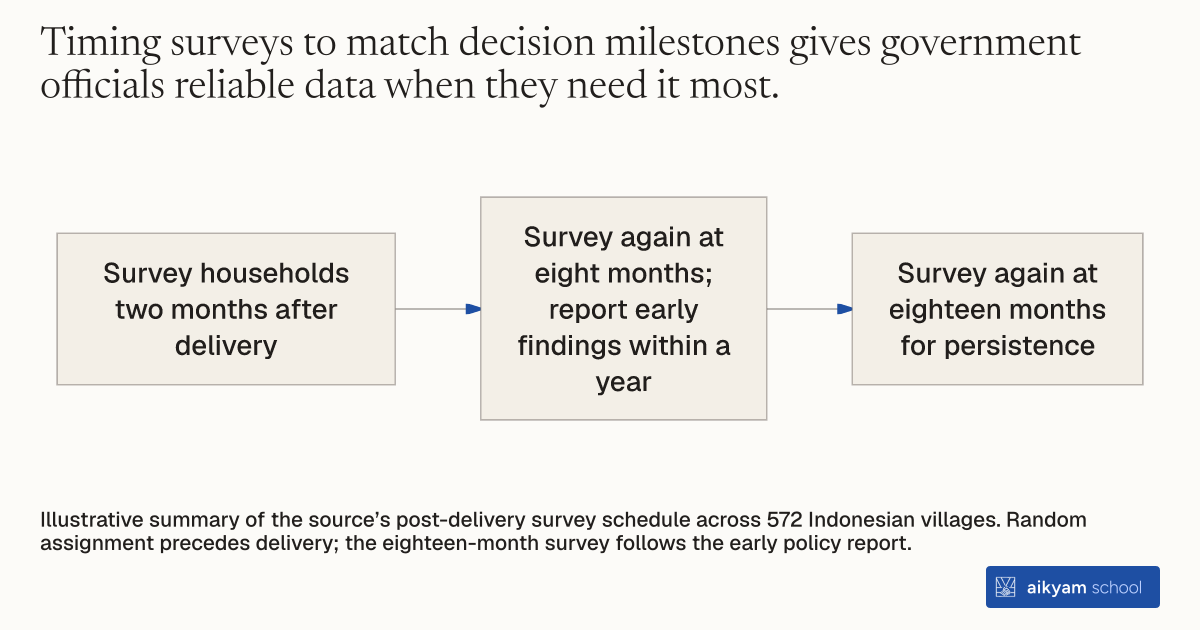
- Survey households two months after delivery
- Survey again at eight months; report early findings within a year
- Survey again at eighteen months for persistence
Illustrative summary of the source’s post-delivery survey schedule across 572 Indonesian villages. Random assignment precedes delivery; the eighteen-month survey follows the early policy report.
See source →How
When to use
Governments need fast, rigorous evidence to decide whether to scale up major social assistance programs across a country. Policymakers often cannot wait years for long-term evaluation studies before making national budget and rollout decisions. Conduct multi-phase household surveys to rapidly evaluate pilot interventions and deliver preliminary results within policy deadlines.
Conduct multi-phase household surveys synchronized with government decision timelines to evaluate policy interventions quickly and rigorously.
- Align the survey evaluation schedule with official government policy deadlines.
- Select target evaluation villages and randomly assign them to treatment and comparison groups.
- Conduct an initial round of household surveys two months after delivering the intervention.
- Execute a second survey round eight months after intervention delivery.
- Perform a third survey round eighteen months after intervention delivery to track long-term persistence.
- Relay preliminary evaluation findings to government decision-makers in less than one year.
Why it works
Rapid data collection allows leaders to base national scale-up choices on scientific proof rather than guesswork.
Example
In Indonesia, researchers surveyed households across 572 villages at two, eight, and eighteen months after mailing benefit cards. They delivered preliminary findings in under a year, leading the national government to scale up identification cards to 15.5 million low-income households in 2013.
About the study
Participants
572 villages across three provinces in Indonesia, surveying eligible and ineligible households.
Study Design
Randomized controlled trial using structured household surveys at two, eight, and eighteen months post-intervention to track benefit quantities, copayments, and program understanding.
Results
Preliminary findings delivered in less than one year informed the national scale-up of identification cards to 15.5 million low-income households reaching over 65 million people, with measured benefit increases persisting across all survey phases up to eighteen months.