Research steps
Combine factory surveys and records
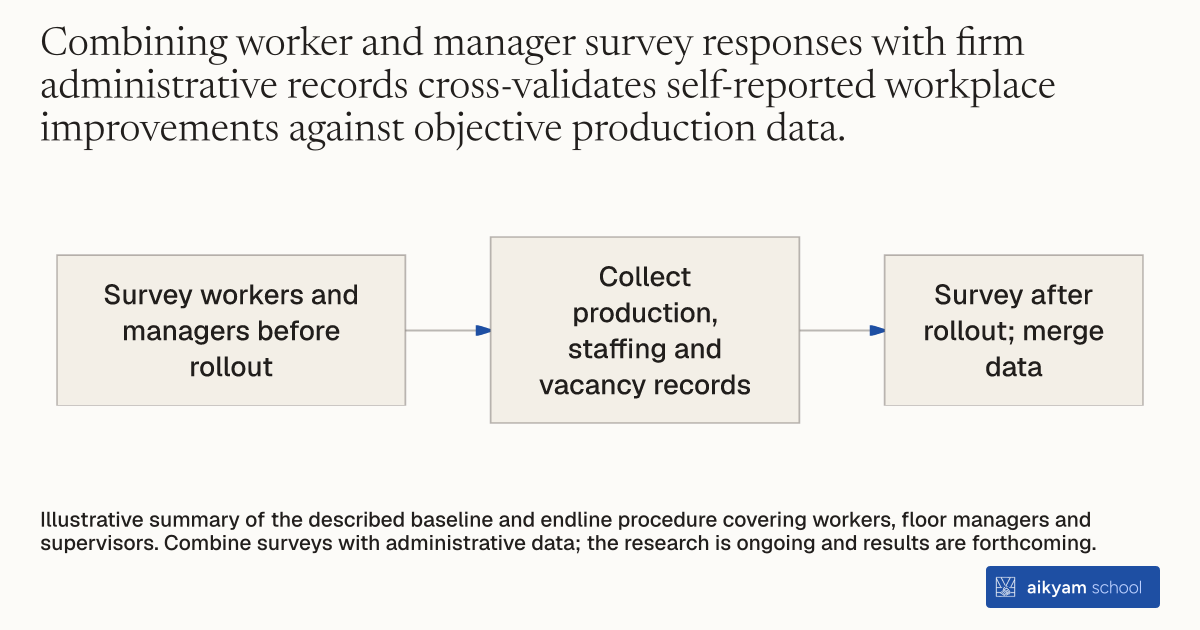
- Survey workers and managers before rollout
- Collect production, staffing and vacancy records
- Survey after rollout; merge data
Illustrative summary of the described baseline and endline procedure covering workers, floor managers and supervisors. Combine surveys with administrative data; the research is ongoing and results are forthcoming.
See source →How
When to use
Evaluating workplace interventions in manufacturing firms requires accurate measurement of worker well-being and operational performance. Relying solely on self-reported surveys or firm records can introduce response biases or miss subjective workplace climate factors. Triangulating data from multiple surveys and administrative databases provides a comprehensive evaluation framework for program managers.
Triangulate survey responses from multiple workforce levels with plant administrative records to measure intervention impacts.
- Evaluators design standardized survey questionnaires for factory workers, floor managers, and supervisors.
- Field staff administer baseline surveys across workers, floor managers, and supervisors prior to program rollout.
- Program analysts collect administrative records on daily plant production, worker retention, hiring rates, and position vacancies.
- Field staff conduct endline surveys with workers, floor managers, and supervisors following the intervention.
- Econometricians merge survey datasets with firm administrative data to track productivity, retention, and promotion equity outcomes.
Why it works
This multi-source tracking ensures accurate estimation of both operational efficiency gains and worker well-being changes.
Example
Evaluators in India combined baseline and endline surveys of workers, floor managers, and supervisors with administrative turnover and production records from Shahi Exports across 53 factories and over 90,000 workers.
About the study
Participants
53 garment factories, 1,200 supervisors, and over 90,000 workers (mostly women from lower-income backgrounds) in Karnataka, Delhi, and Haryana, India.
Study Design
Cluster randomized controlled trial combining baseline and endline surveys of workers, supervisors, and floor managers with firm administrative data.
Results
Research is ongoing with results forthcoming on hiring rates, retention, productivity, and promotion equity.