Research steps
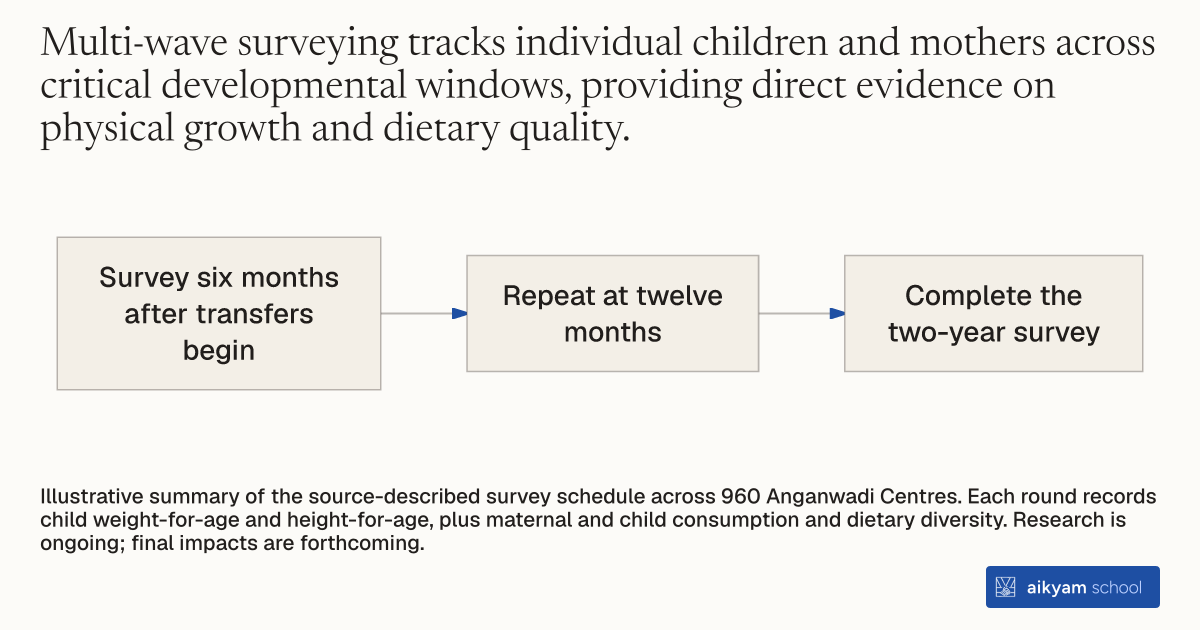
Repeat child and maternal nutrition surveys
- Survey six months after transfers begin
- Repeat at twelve months
- Complete the two-year survey
Illustrative summary of the source-described survey schedule across 960 Anganwadi Centres. Each round records child weight-for-age and height-for-age, plus maternal and child consumption and dietary diversity. Research is ongoing; final impacts are forthcoming.
See source →How
When to use
In rural areas of Jharkhand, high rates of child undernutrition and maternal anemia require multi-wave data collection to evaluate social protection programs. Standard administrative tracking often fails to measure home-level dietary changes or physical growth markers accurately. Surveyors conduct structured household surveys at six months, twelve months, and two years to track nutritional and developmental impacts on mothers and young children.
Conduct structured multi-wave household surveys to collect anthropometric measurements and dietary data from mothers and children.
- Surveyors visit registered households across 960 Anganwadi Centers six months after cash transfers begin.
- Surveyors measure child weight-for-age and height-for-age to track physical growth trajectory.
- Surveyors record dietary diversity and food consumption patterns for both the mother and the child.
- Surveyors return at twelve months to conduct follow-up anthropometric measurements and dietary assessments.
- Surveyors conduct a final round of surveys two years after transfer initiation to assess long-term health and growth outcomes.
Why it works
Collecting data at fixed intervals allows researchers to determine whether cash transfers improve long-term nutritional outcomes compared to control groups.
Example
In rural Jharkhand, researchers surveyed mothers and children across 960 Anganwadi Centers at six months, twelve months, and two years to evaluate child growth metrics and maternal dietary diversity across cash transfer treatment arms.
About the study
Participants
Pregnant women, lactating mothers, and young children across 960 Anganwadi Centers in rural Jharkhand, India, where 43 percent of children under five are stunted.
Study Design
Multi-wave randomized evaluation collecting anthropometric measurements (child weight-for-age, height-for-age) and dietary consumption data at six, twelve, and twenty-four months across 960 Anganwadi Centers.
Results
Research is ongoing and final impact results are forthcoming; baseline data showed that 43 percent of children under five are stunted and 42 percent are underweight in Jharkhand.